Bust (sculpture)

Gian Lorenzo Bernini, Bust of Louis XIV, 1665
A bust is a sculpted or cast representation of the upper part of the human figure, depicting a person's head and neck, and a variable portion of the chest and shoulders. The piece is normally supported by a plinth. The bust is generally a portrait intended to record the appearance of an individual, but may sometimes represent a type. They may be of any medium used for sculpture, such as marble, bronze, terracotta, wax or wood.

Unidentified woman, by Joseph Chinard, terracotta, 1802
Contents
1 Antiquity
2 Pictorial timeline
3 See also
4 Notes
5 References
6 External links
Antiquity
Sculptural portrait heads from classical antiquity, stopping at the neck, are sometimes displayed as busts. However, these are often fragments from full-body statues, or were created to be inserted into an existing body, a common Roman practice;[1] these portrait heads are not included in this article. Equally, sculpted heads stopping at the neck are sometimes mistakenly called busts.
The portrait bust was a Hellenistic Greek invention, though very few original Greek examples survive, as opposed to many Roman copies of them. There are four Roman copies as busts of Pericles with the Corinthian helmet, but the Greek original was a full-length bronze statue. They were very popular in Roman portraiture.[2]
The Roman tradition may have originated in the tradition of Roman patrician families keeping wax masks, perhaps death masks, of dead members, in the atrium of the family house. When another family member died, these were worn by people chosen for the appropriate build in procession at the funeral, in front of the propped-up body of the deceased, as an "astonished" Polybius reported, from his long stay in Rome beginning in 167 BC.[3] Later these seem to have been replaced or supplemented by sculptures. Possession of such imagines maiorum ("portraits of the ancestors") was a requirement for belonging to the Equestrian order.[4]
Pictorial timeline
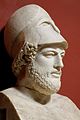
Pericles with the Corinthian helmet (marble, Roman after a Greek original, c. 430 BC)

Bronze bust of Lucius Junius Brutus, the Capitoline Brutus, late 4th century BC to early 3rd century BC
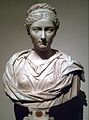
The Empress Vibia Sabina (c. 130 AD)
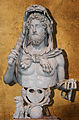
Emperor Commodus dressed as Hercules, c. 191 CE, in the late imperial "baroque" style.
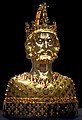
Reliquary bust of Charlemagne (gold, Aachen Cathedral treasury, 14th century)

Giuliano de' Medici by Andrea del Verrocchio (terracotta, 1475–85)

Jakob Fugger the Rich by Conrat Meit (polychrome wood, c. 1515)

Reliquary of a saint (oak, paint, gilding, 1520–30)

Terracotta modello by Alessandro Algardi of Cardinal Paolo Emilio Zacchia, c. 1650

Jules Hardouin-Mansart by Jean-Louis Lemoyne (marble, 1703)
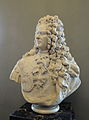
Menshikov by Rastrelli (1717)

Bust of a Man[5] from the studio of Francis Harwood (black limestone, c. 1758)

Simplicity of the Highest Degree, ninth in a series of character heads by Franz Xaver Messerschmidt (alabaster, after 1770)

Étienne Vincent-Marniola by Joseph Chinard (terracotta, 1809)
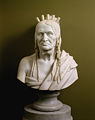
Chief Beshekee by Francis Vincenti (marble, 1855–56)

The Veiled Nun by Giuseppe Croff (marble, 1860)

Mater Dolorosa by Jean-Baptiste Carpeaux (terracotta, 1869–70)
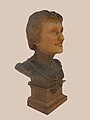
Sarah Bernhardt by Jean-Désiré Ringel d'Illzach (wax, 1895)
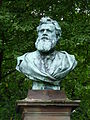
Viktor Nessler by Alfred Marzolff (bronze, 1890s)
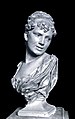
Jeanne Granier by Francis de Saint-Vidal (late 19th century)
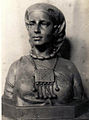
Faduma Ali, wife of Prince Luigi Amedeo, Duke of the Abruzzi (Italian Somaliland, c. 1920s)

Keys To Community (featuring Benjamin Franklin) by James Peniston (2007)


See also
- Herma
- Portrait
Notes
^ Stewart, 47
^ Stewart, 46-47
^ Belting, 116-117
^ Belting, 116
^ Previously known as The Blackamoor.
References
Belting, Hans, An Anthropology of Images: Picture, Medium, Body, 2014, Princeton University Press, .mw-parser-output cite.citationfont-style:inherit.mw-parser-output qquotes:"""""""'""'".mw-parser-output code.cs1-codecolor:inherit;background:inherit;border:inherit;padding:inherit.mw-parser-output .cs1-lock-free abackground:url("//upload.wikimedia.org/wikipedia/commons/thumb/6/65/Lock-green.svg/9px-Lock-green.svg.png")no-repeat;background-position:right .1em center.mw-parser-output .cs1-lock-limited a,.mw-parser-output .cs1-lock-registration abackground:url("//upload.wikimedia.org/wikipedia/commons/thumb/d/d6/Lock-gray-alt-2.svg/9px-Lock-gray-alt-2.svg.png")no-repeat;background-position:right .1em center.mw-parser-output .cs1-lock-subscription abackground:url("//upload.wikimedia.org/wikipedia/commons/thumb/a/aa/Lock-red-alt-2.svg/9px-Lock-red-alt-2.svg.png")no-repeat;background-position:right .1em center.mw-parser-output .cs1-subscription,.mw-parser-output .cs1-registrationcolor:#555.mw-parser-output .cs1-subscription span,.mw-parser-output .cs1-registration spanborder-bottom:1px dotted;cursor:help.mw-parser-output .cs1-hidden-errordisplay:none;font-size:100%.mw-parser-output .cs1-visible-errorfont-size:100%.mw-parser-output .cs1-subscription,.mw-parser-output .cs1-registration,.mw-parser-output .cs1-formatfont-size:95%.mw-parser-output .cs1-kern-left,.mw-parser-output .cs1-kern-wl-leftpadding-left:0.2em.mw-parser-output .cs1-kern-right,.mw-parser-output .cs1-kern-wl-rightpadding-right:0.2em
ISBN 0691160961, 9780691160962, google books- Stewart, Peter, Statues in Roman Society: Representation and Response, 2003, Oxford University Press,
ISBN 0199240949, 9780199240944, google books
External links
 | Wikimedia Commons has media related to busts. |
 | Look up bust in Wiktionary, the free dictionary. |
- Livius.org: Bust gallery of famous ancient Greeks
- Oxford definition
- Dictionary.com definition

