Coordinates: 51°54′26″N 10°25′48″E / 51.90722°N 10.43000°E / 51.90722; 10.43000 Coordinates: 51°54′26″N 10°25′48″E / 51.90722°N 10.43000°E / 51.90722; 10.43000 Country Germany State Lower Saxony District Goslar Government
• Lord Mayor Dr Oliver Junk[1] [2] (CDU) Area
• Total 163.71 km2 (63.21 sq mi) Elevation
255 m (837 ft) Population (2017-12-31)[3]
• Total 51,128 • Density 310/km2 (810/sq mi) Time zone Postal codes 38640, 38642, 38644
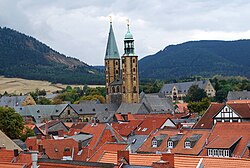
Dialling codes 05321, 05325 Vehicle registration GS Website www.goslar.de Goslar UNESCO World Heritage site View to the North with the Hildesheim downs in the background. Photograph taken from the Maltermeister Tower
Part of Criteria Cultural: i, iv Reference 623-001 Inscription 1992 (16th Session) Extensions 2010 Area 363.3 ha Buffer zone 376.1 ha
Goslar is a historic town in Lower Saxony, Germany. It is the administrative centre of the district of Goslar and located on the northwestern slopes of the Harz mountain range. The Old Town of Goslar and the Mines of Rammelsberg are UNESCO World Heritage Sites.
Contents 1 Geography 1.1 Neighbouring municipalities 1.2 Town districts 1.3 Climate 2 History 3 Politics 3.1 Town council 3.2 Lord Mayor 3.3 Members of Parliament 4 Twin towns 5 Culture and sights 5.1 Theatre 5.2 Museums 5.3 Religion 5.4 Sports 5.5 Celebrations and Events 6 Economy and infrastructure 6.1 Transport 6.2 Media 6.3 Education 7 Notable people 8 References 9 External links Geography Goslar is situated in the middle of the upper half of Germany, about 40 kilometres (25 miles) south of Braunschweig and about 70 km (43 mi) southeast of the state capital Hannover. The Schalke mountain is the highest elevation within the municipal boundaries at 762 metres (2,500 feet). The lowest point of 175 m (574 ft) is near the Oker river. Geographically, Goslar forms the boundary between the Hildesheim Börde which is part of the Northern German Plain, and the Harz range, which is the highest, northern-most extension of Germany's Central Uplands. The Hildesheim Börde is characterised by plains with rich clay soils – used agriculturally for sugar beet farming – interlaced with several hill ranges commonly known as the Hildesheim Forest and Salzgitter Hills. In the northeast the Harly Forest stretches down to the Oker river, in the east Goslar borders on the German state of Saxony-Anhalt.
Immediately to the south, the Harz range rise above the historic borough at a height of 636 m (2,087 ft) at Mt. Rammelsberg. Extended forests dominate the landscape. The major rivers crossing the municipal boundaries is the Oker with its Gose/Abzucht and Radau tributaries. The eponymic Gose River originates approximately 9 kilometres (6 miles) south-west of Goslar at the Auerhahn Pass (638 m (2,093 ft)) east of the Bocksberg mountain. At the northern foot of the Herzberg (632 m (2,073 ft)) it meets the smaller Abzucht stream, before it flows into the Oker. The Dörpke and Gelmke streams also flow from the Harz foothills to the south into the Goslar municipal area, where they discharge into the Abzucht.
Neighbouring municipalities (clockwise from the North): Liebenburg, Schladen-Werla (Wolfenbüttel District), Osterwieck (Harz District, Saxony-Anhalt), Bad Harzburg, Clausthal-Zellerfeld (Oberharz), and Langelsheim.
Town districts The township currently comprises 18 districts (Stadtteile ):
Old Town (upper and lower borough and town centre) Rammelsberg with Siemensviertel and Rosenberg Georgenberg with Kattenberg Steinberg Sudmerberg Jürgenohl with Kramerswinkel Baßgeige Ohlhof Incorporated in 1972:
Hahndorf with Grauhof Jerstedt Oker Incorporated in 2014:
Immenrode Lengde Lochtum Weddingen Wiedelah
Climate Climate data for Goslar, Niedersachsen Month Jan Feb Mar Apr May Jun Jul Aug Sep Oct Nov Dec Year Average high °C (°F) 2 2 7 10 16 18 21 21 17 13 7 4 11.5 Average low °C (°F) −2 −3 1 3 7 11 12 12 10 6 2 0 4.9 Source: World Weather Online[4]
History
Abzucht river in the Old Town
Main article: History of Goslar
Iron ore mining was common in the Harz region since Roman times; the earliest known evidences for quarying and smelting date back to the 3rd century AD. Ancient burial objects made of Harz ore have even been discovered during excavations in England. The settlement on the Gose creek was first mentioned in a 979 deed issued by Emperor Otto II; it was located in the Saxon homelands of the Ottonian dynasty and probably a royal palace (Königspfalz ) already existed at the site. It became even more important when extensive silver deposits were discovered at the nearby Rammelsberg, today a mining museum.
When Otto's descendant Henry II began to convene Imperial synods at the Goslar palace from 1009 onwards, Goslar gradually replaced the Royal palace of Werla as a central place of assembly in the Saxon lands; a development that was again enforced by the Salian ("Franconian") emperors. Conrad II, once elected King of the Romans, celebrated Christmas 1024 in Goslar and had the foundations laid for the new Imperial Palace (Kaiserpfalz Goslar ) the next year.
Goslar became the favourite residence of Conrad's son Henry III who stayed at the palace about twenty times. Here he received King Peter of Hungary as well as the emissaries of Prince Yaroslav of Kiev, here he appointed bishops and dukes. His son and successor Henry IV was born here on 11 November 1050. Henry also had Goslar Cathedral erected and consecrated by Archbishop Herman of Cologne in 1051; shortly before his death in 1056, Emperor Henry III met with Pope Victor II in the church, emphasizing the union of secular and ecclesiastical power. His heart was buried in Goslar, his body in the Salian family vault in Speyer Cathedral. Of the cathedral only the northern porch survived; the main building was torn down in the early 19th century.
Under Henry IV, Goslar remained a centre of Imperial rule; however, conflicts intensified such as in the violent Precedence Dispute at Pentecost 1063. While Henry aimed to secure the enormous wealth deriving from the Rammlesberg silver mines as a royal demesne, the dissatisfaction of local nobles escalated with the Saxon Rebellion in 1073–75. In the subsequent Great Saxon Revolt, the Goslar citizens sided with anti-king Rudolf of Rheinfelden, who held a princely assembly here in 1077, and with Hermann of Salm, who was crowned king in Goslar by Archbishop Siegfried of Mainz on 26 December 1081. brought Goslar the status of an Imperial City.
In Spring 1105 Henry V convened the Saxon estates at Goslar, to gain support for the deposition of his father Henry IV. Elected king in the following year, he held six Imperial Diets at the Goslar Palace during his rule. The tradition was adopted by his successor Lothair II and even by the Hohenstaufen rulers Conrad III and Frederick Barbarossa. After his election in 1152, King Frederick appointed the Welf duke Henry the Lion Imperial Vogt (bailiff) of the Goslar mines; nevertheless, the dissatisfied duke besieged the town and at a 1173 meeting in Chiavenna demanded his enfeoffment with the estates in turn for his support on Barbarossa's Italian campaigns. When Henry the Lion was finally declared deposed in 1180, he had the Rammelsberg mines devastated.
Goslar's importance as an Imperial residence began to decline under the rule of Barbarossa's descendants. During the German throne dispute the Welf king Otto IV laid siege to the town in 1198 but had to yield to the forces of his Hohenstaufen rival Philip of Swabia. Goslar was again stormed and plundered by Otto's troops in 1206. Frederick II held the last Imperial Diet here; with the Great Interregnum upon his death in 1250, Goslar's Imperial era ended.
While the Emperors withdraw from Northern Germany, civil liberties in Goslar were strengthened. Market rights date back to 1025; a municipal council (Rat ) was first mentioned in 1219. The citizens strived for control of the Rammelsberg silver mines and in 1267 joined the Hanseatic League. Beside mining in the Upper Harz, commerce and trade in Gose beer, later also slate and vitriol, became important. By 1290 the council had obtained Vogt rights, confirming Goslar's status as a free imperial city. In 1340 its citizens were vested with Heerschild rights by Emperor Louis the Bavarian. The Goslar town law set an example for numerous other municipalities, like the Goslar mining law codified in 1359.
Early modern times saw both a mining boom and rising conflicts with the Welf Dukes of Brunswick-Lüneburg, mainly with Prince Henry V of Wolfenbüttel who seized the Rammelsberg mines and extended Harz forests in 1527. Though a complaint was successfully lodged with the Reichskammergericht by the Goslar citizens, a subsequent gruelling feud with the duke lasted for decades. Goslar was temporarily placed under Imperial ban, while the Protestant Reformation was introduced in the city by theologian Nicolaus von Amsdorf who issued a first church constitution in 1531. To assert independence, the citizens in 1536 joined the Schmalkaldic League against the Catholic policies of the Habsburg emperor Charles V. The Schmalkaldic forces indeed occupied the Wolfenbüttel lands of Henry V, however, when they were defeated by Imperial forces at the 1547 Battle of Mühlberg, the Welf duke continued his reprisals.
In 1577 the Goslar citizens signed the Lutheran Formula of Concord. After years of continued skirmishes, they finally had to grant Duke Henry and his son Julius extensive mining rights which ultimately edged out the city council. Nevertheless, several attempts by the Brunswick dukes to incorporate the Imperial city were rejected. Goslar and its economy was hit hard by the Thirty Years' War, mainly by the Kipper und Wipper financial crisis in the 1620s which led to several revolts and pogroms. Facing renewed aggressions by Duke Christian the Younger of Brunswick, the citizens sought support from the Imperial military leaders Tilly and Wallenstein . The city was occupied by the Swedish forces of King Gustavus Adolphus from 1632 to 1635; in 1642 a peace agreement was reached between Emperor Ferdinand III and the Brunswick duke Augustus the Younger. The hopes of the Goslar citizens to regain the Rammelsberg mines were not fulfilled.
Goslar remained loyal to the Imperial authority, solemnly celebrating each accession of a Holy Roman Emperor. While strongly referring to its great medieval traditions, the city continuously decreased in importance and got into rising indebtedness. When Johann Wolfgang von Goethe stayed at Goslar in 1777, he called it "an Imperial city rotted in and with its privileges". The Prelude .[5]
First administrative reforms were enacted by councillors of the Siemens family. Nevertheless, the status of Imperial immediacy was finally lost, when Goslar was annexed by Prussian forces during the Napoleonic Wars in 1802, confirmed by the German Mediatisation the next year. Under Prussian rule, further reforms were pushed ahead by councillor Christian Wilhelm von Dohm. Temporarily part of the Kingdom of Westphalia upon the Prussian defeat at the 1806 Battle of Jena–Auerstedt, Goslar finally was assigned to the newly established Kingdom of Hanover by resolution of the Vienna Congress. The cathedral was sold and torn down from 1820 to 1822, bitterly mourned by Heinrich Heine in his Harzreise travelogue. Again under Prussian rule after the Austro-Prussian War of 1866, Goslar became a popular retirement residence (Pensionopolis ) and a garrison town of the Prussian Army. The Hohenzollern kings and emperors had the Imperial Palace restored, including the mural paintings by Hermann Wislicenus.
After the Nazi seizure of power in 1933, Reich Minister Richard Walther Darré made Goslar the seat of the agricultural Reichsnährstand corporation. In 1936, the city obtained the title of a Reichsbauernstadt . In the course of the German re-armament, a Luftwaffe airbase was built north of the town and several war supplier companies located in the vicinity, including subcamps of the Buchenwald and Neuengamme concentration camps. Nevertheless, the historic town escaped strategic bombing during World War II.
Part of the British occupation zone from 1945, Goslar was the site of a displaced persons camp. During the Cold War era the city near the inner German border was a major garrison town for the West German army, the border police as well as the French Forces in Germany. After the fall of the Berlin wall, the barracks were vacated and a major economic factor was lost. The Rammelberg mines were finally closed in 1988, after a millennial history of mining.
In the summer of 2018, a bottled typewritten message dated March 26, 1930 was discovered in the roof of Goslar Cathedral, signed by four roofers who bemoaned the economic state of that country.[6] The bottle was discovered by a roofer who was the grandson of one of the signatories, who had been an 18-year-old roofing apprentice in 1930.[6] Goslar's mayor replaced the bottle with a copy of the 1930 message, adding his own confidential message.[6]
Demographics Year Inhabitants 1821 7,547 1848 9,748 1871 11,900 1885 15,997 1905 23,640 1925 27,881
Year Inhabitants 1933 29,538 1939 34,371 1946 47,855 1950 53,804 1956 53,236
Year Inhabitants 1961 54,151 1968 53,819 1970 52,649 1975 53,963 1980 52,556
Year Inhabitants 1985 49,636 1990 46,251 1995 46,142 2000 44,278 2005 43,119
(count: December 31 of each year)
Politics
Goslar's Medieval Imperial Eagle
Door knocker with the name "Brunswick Horse" at the front door of a half-timbered house dating from the year 1719 in the town centre of Goslar.
Town council For the legislature from 1 November 2016 until 31 October 2021, the seats were allocated as follows:
Lord Mayor Dr Oliver Junk was elected as Lord Mayor in September 2011.
Members of Parliament European (Constituency: Southern Lower Saxony), Godelieve Quisthoudt-Rowohl (CDU), Erika Mann (SPD)Bundestag (Constituency 52: Goslar, Northeim, Osterode), First: Wilhelm Priesmeier (SPD), List: Hans Georg Faust (CDU)Landtag Lower Saxony (Constituency 16: Goslar), First: Petra Emmerich-Kopatsch (SPD), List: Dorothee Prüssner (CDU)Twin towns See also: List of twin towns and sister cities in Germany
Goslar is twinned with:
[7] Culture and sights
war memorial 1870/1871 at barrack yard
war memorial 1914-1918 at Thomaswall
Mediaeval Imperial Palace (
Kaiserpfalz )
The Zwinger tower and pond
Memorial to the fallen riflemen of the 10th Hanover Rifle Battalion in the Franco-Prussian War 1871/1871 (now at the Kahnteich) Memorial to the fallen riflemen of the 10th Hanover Rifle Battalion in World War I 1914-1918 Theatre The Odeon Theatre is the town's major theatre venue. It has been recently refurbished. It is host to several productions of visiting theatre companies and music groups.
The alternative theatre Culture Power Station Harz or Kulturkraftwerk Harz is housed in a disused powerstation. Being run by volunteers, it produces contemporary theatre, comedy and hosts mostly alternative cultural events. Here the annual Goslar Fringe Culture Days are held from the start to mid June.
Museums Museum and visitor's mine Rammelsberg, an Anchor Point of ERIH, The European Route of Industrial Heritage Museum in the Kaiserpfalz , a 19c reconstruction of the mediaeval imperial palace Monks' House, Mönchehaus Museum for Contemporary and Modern Arts Goslar Museum Museum in the Gothic Town Hall Religion Protestant: -LutheranCongregation Marktkirche, Market Church (build 1151, North Tower mountable) Congregation Neuwerk, Newark Church Congregation St. Stephani, Saint Stephen Congregation Zum Frankenberge, Frankenberg Church Congregation Gustav-Adolf-Stabkirche, Gustav Adolf stave church in Hahnenklee Congregation Martin-Luther-Kirche, Martin Luther Church Congregation St.Paulus Kirche, St. Paul's Church, in Oker Congregation St. Georg, St. George Congregation St. Johannes, St. John Parish Church St. Kilians in Hahndorf Congregation St. Lukas, St. Luke Parish Church St. Matthäus, St. Matthew's, in Jerstedt Congregation St. Peter BaptistCongregation Christuskirche, Church of Christ Roman CatholicCongregation St. Jakobi, Saint James the Greater (built in 1073, Goslar's oldest romanesque church still in use) Congregation Maria Schnee, St. Mary in the Snow in Hahnenklee Congregation St. Barbara (part of St. James's) Congregation St. Konrad, St. Conrad (part of St. James) in Oker Congregations St. Benno & St. George Abbey St. George Islamic FaithMosque of the Turkish-German Society Goslar Mosque Sports Situated at the foot of the Harz hills, Goslar offers a great deal of outdoor pursuit, from swimming to rock climbing; from motor sports and aviation to sailing and cross-country biking.
The oldest and most traditional sports club is the MTV Goslar (founded in 1849). Its main facilities, a football pitch and gymnasium are located at the Golden Meadow (Goldene Aue ) site.
The football department of Goslarer SC 08 earned the right to play in the fourth division Regionalliga Nord in 2009-10 after winning the Oberliga Niedersachsen championship.[8]
Celebrations and Events In the year 2006 Goslar hosted the Salier Year to celebrate the foundation of this ancient German Imperial dynasty a millennium ago.
Other events include:
Annual award (since 1975) of the "Imperial Ring" to a personality who has made an outstanding contribution to society and the arts. Its laureates include Henry Moore, Joseph Beuys, Christo, Dani Karavan etc. Goslar International Concerto Days, Mid to End August The Goslar Fair, Beginning to Mid July Annual Artisans market in the old town, usually beginning of August Old Town Festival, mid-September Hanseatic Days, Spring (usually during the Easter holidays)
Panoramic view from the market church of Goslar
Economy and infrastructure
Half-timbered houses at the river Gose
The town centre of Goslar serves as a regional shopping centre to the Northern Harz region. Here department stores, several supermarkets, elegant boutiques and restaurants can be found. Once weekly, there is also a market, where farmers sell their local produce. There are also several car dealerships in the borough, some of whom specialise in either discount/reimport or custom car sales.
The tourism sector is a booming sector in Goslar. Several hotels and bed and breakfasts are located in or near the town's centre. In addition, the town has become a popular resort for the elderly and there are many care homes in the town.
Goslar has become a popular conference venue. The Achtermann Hotel and the Kaiserpfalz are popular conference centres, host to the annual German Road & Transport Tribunal Days: the Deutscher Verkehrsgerichtstag
Largest employers in Goslar are H.C. Starck (chemistry company), the tourism sector, and the civil service. Many residents of Goslar commute to Salzgitter, where car production, steel works and white collar jobs are based.
The Dr.-Herbert-Nieper-Krankenhaus is a privately owned hospital of the Asklepios Harzkliniken group serving the greater Harz region. A new annex for intensitive medicine is under construction. There are several general practitioners, dentists, and specialist practitioners distributed across the town. There is an emergency service in place.
Transport Goslar has excellent road links, as well as rail links connecting it to the major European population centres. Goslar also serves as a major transport hub for the Upper Harz mountains (highest peak at 1,141 m (3,744 ft) altitude).
With the A 7 and the A 395 there are two main Autobahns/Highways within 20 minutes reach of Goslar.
Goslar is served by the German Railway network (Deutsche Bahn) lines Hanover–Goslar–Halle (Saxony-Anhalt) as well as Brunswick–Goslar–Kreiensen. The central railway station is located in the vicinity of the town centre. There is a park-and-ride system for commuters to Brunswick and Hanover.
At the railway station there is a central bus station with buses travelling routinely to various destinations in the Harz mountains. The buses are from DB Stadtverkehr.
Media The regional newspaper is the Goslar Chronicle Goslarsche Zeitung, which has an estimated daily readership of 90,000. The General-Anzeiger is a gazette owned by the Heinrich Bauer publishing group with an editorial office in Goslar. Aside from this there are two freely distributed gazettes.
Radio Okerwelle GoslarRadio is the regional private radio station based in Brunswick, which broadcasts contemporary music, information and news in the German language to the Brunswick region.
Education The three tier education system in Goslar district falls under Lower-Saxon legislation. The language of instruction at all schools is German. The nine primary schools are distributed across the entire municipality and the associated hamlets. There are two advanced secondary schools (5-12/13), the Christian-von-Dohm-Gymnasium, and the more traditional Ratsgymnasium, both of which prepare their students for an academic career. Three intermediate level schools (5-10), the Andre-Mouton Realschule, the Realschule Hoher Weg, and the Realschule Goldene Aue prepare their pupils for a professional career. Furthermore, two vocational schools (5-9/10) exist: the Hauptschule Oker, and the Hauptschule Kaiserpfalz. The Sonderschule caters to children with learning difficulties and special needs.
The supplementary public Waldorf school Harz – Branch Goslar, educates its students along a more spiritual line termed anthroposophy, which is based on the teachings of the Austrian pedagogue Rudolf Steiner.
At the 10-12 level there are four job-training colleges located at Goslar in crafts, economics, and care for the elderly for students from Goslar district and beyond. There are two public vocational schools offering part-time education within the German dual vocational education and training system and full-time education.[9] BBS 1 Goslar -Am Stadtgarten- is focused on education in business administration, economics, health services and information and communications technology (ICT).[10] BBS Goslar-Baßgeige/Seesen is concentrated on education in mechanical, electrical and textile engineering; natural sciences: chemistry, physics, biology; food services, domestic science and industry and administration.[11]
The nearest university from Goslar is the old venerable Engineering and Mining School at Clausthal-Zellerfeld situated in the Upper Harz mountains some 21 kilometres (13 miles) south of Goslar within Goslar district. Some 80 km (50 mi) to the south the highly acclaimed University of Göttingen (founded by King George II of Great Britain) is based.
The adult-education program (Volkshochschule ) of the Goslar district is dedicated to lifelong learning.
Notable people
Ernst Jünger, Philipp Jenninger, Liselotte Jünger
innere Emigration (inner emigration), distancing himself from direct political commentary, as he left Berlin following the Gestapo search of his house in April 1933Siemens Family. The ancestral home of the Siemens family, who can count toward their more famous offspring, the Prussian-British-Russian industrial pioneers Werner von Siemens, Sir William Siemens and Carl von Siemens, is in Goslar [12] References ^ Bayreuther is OB in Goslar - Frankenpost - 13.11.2011 p2 ^ Electionresult 2011 in Goslar Archived 2012-04-02 at the Wayback Machine. ^ Landesamt für Statistik Niedersachsen, Tabelle 12411: Fortschreibung des Bevölkerungsstandes, Stand 31. Dezember 2017 ^ "Goslar, Niedersachsen Monthly Climate Average, Germany". Retrieved December 18, 2016 . .mw-parser-output cite.citationfont-style:inherit.mw-parser-output qquotes:"""""""'""'".mw-parser-output code.cs1-codecolor:inherit;background:inherit;border:inherit;padding:inherit.mw-parser-output .cs1-lock-free abackground:url("//upload.wikimedia.org/wikipedia/commons/thumb/6/65/Lock-green.svg/9px-Lock-green.svg.png")no-repeat;background-position:right .1em center.mw-parser-output .cs1-lock-limited a,.mw-parser-output .cs1-lock-registration abackground:url("//upload.wikimedia.org/wikipedia/commons/thumb/d/d6/Lock-gray-alt-2.svg/9px-Lock-gray-alt-2.svg.png")no-repeat;background-position:right .1em center.mw-parser-output .cs1-lock-subscription abackground:url("//upload.wikimedia.org/wikipedia/commons/thumb/a/aa/Lock-red-alt-2.svg/9px-Lock-red-alt-2.svg.png")no-repeat;background-position:right .1em center.mw-parser-output .cs1-subscription,.mw-parser-output .cs1-registrationcolor:#555.mw-parser-output .cs1-subscription span,.mw-parser-output .cs1-registration spanborder-bottom:1px dotted;cursor:help.mw-parser-output .cs1-hidden-errordisplay:none;font-size:100%.mw-parser-output .cs1-visible-errorfont-size:100%.mw-parser-output .cs1-subscription,.mw-parser-output .cs1-registration,.mw-parser-output .cs1-formatfont-size:95%.mw-parser-output .cs1-kern-left,.mw-parser-output .cs1-kern-wl-leftpadding-left:0.2em.mw-parser-output .cs1-kern-right,.mw-parser-output .cs1-kern-wl-rightpadding-right:0.2em^ "In Our Time". BBC Radio 4. Retrieved 5 April 2018 . ^ a b c Beck, Luisa (September 19, 2018). "A German roofer working on a cathedral found a message in bottle, written by his grandfather". The Washington Post . Archived from the original on September 20, 2018. Difficult times of war lie behind us. ... We hope for better times soon to come. ^ "Ra'anana: Twin towns & Sister cities - Friends around the World". raanana.muni.il . Archived from the original on 30 April 2010. Retrieved 24 March 2010 . ^ Goslar steigt in die Regionalliga auf – Erlebnisbericht: VfB Oldenburg – Goslarer SC 08 (in German) Game report, accessed: 9 July 2009 Archived June 12, 2009, at the Wayback Machine. ^ Goslar, Landkreis. "www.landkreis-goslar.de - Schulen". www.landkreis-goslar.de . Retrieved 5 April 2018 . ^ "About – BBS 1 Goslar -Am Stadtgarten-". www.bbs1goslar.de . Retrieved 5 April 2018 . ^ "Englisch: Berufsbildende Schulen Goslar-Baßgeige/Seesen". www.bbs-bassgeige.de . Retrieved 5 April 2018 . ^ Research Library for the History of Education, German Institute for International Educational Research, Berlin External links Wikimedia Commons has media related to Goslar
Wikivoyage has a travel guide for Goslar
(in English) Sound and video of Marktplatz clock Members of the Hanseatic League by quarter
Chief cities shown in .mw-parser-output .smallcapsfont-variant:small-capssmallcaps . italics .Wendish
Lübeck Anklam Demmin Greifswald Hamburg Kolberg (Kołobrzeg) Lüneburg Rostock Rügenwalde (Darłowo) Stettin (Szczecin) Stolp (Słupsk) Stockholm Stralsund Visby Wismar
Saxon
Brunswick
Berlin Bremen Erfurt Frankfurt an der Oder Goslar Mühlhausen Nordhausen
Baltic
Danzig '"`UNIQ--templatestyles-00000021-QINU`"'(Gdańsk)
Breslau (Wrocław) Dorpat (Tartu) Elbing (Elbląg) (Kaliningrad) Cracow (Kraków) Reval (Tallinn) Riga (Rīga) Thorn (Toruń)
Westphalian
Cologne 1 Dortmund 1
Deventer Groningen Kampen Münster Osnabrück Soest
Kontore
Principal (Bergen) Hanzekantoor (London) Peterhof (Novgorod) Subsidiary Bishop's Lynn Falsterbo Ipswich Kaunas Malmö Polotsk Pskov
Other cities Bristol Boston Leith Herford Hull Newcastle Stargard Yarmouth York Zutphen Zwolle 1 2
Lower Saxon Circle (1500–1806) of the Holy Roman Empire
Ecclesiastical 1 1 Hildesheim Lübeck 1 2 1 Secular 3 4 5 5 6 7 Wolfenbüttel Glückstadt 8 9 10 Schwerin 11 12 Regenstein 5 Cities Bremen Goslar Hamburg Lübeck Mühlhausen Nordhausen 1 2 3 4 5 6 7 8 9 10 11 12 (Lower) Saxon · Unencircled territories
For official site names, see each article or the List of World Heritage Sites in Germany.
Northern ADGB Trade Union School Berlin Modernism Housing Estates Fagus Factory in Alfeld Museumsinsel (Museum Island), Berlin Hanseatic City of Lübeck Palaces and Parks of Potsdam and Berlin Historic Centres of Stralsund and Wismar Central Garden Kingdom of Dessau-Wörlitz Dresden Elbe Valley (delisted in 2009) Luther Memorials in Eisleben and Wittenberg Haus am Horn 1 Naumburg Cathedral Collegiate Church, Castle, and Old Town of Quedlinburg Wartburg Castle Classical Weimar Western Aachen Cathedral Castles of Augustusburg and Falkenlust at Brühl Bergpark Wilhelmshöhe Cologne Cathedral Carolingian Westwork and Civitas Corvey Upper Middle Rhine Valley Speyer Cathedral Völklingen Ironworks Zollverein Coal Mine Industrial Complex in Essen Southern Abbey and Altenmünster of Lorsch Town of Bamberg Caves and Ice Age Art in the Swabian Jura 2 Maulbronn Monastery Complex Margravial Opera House Monastic Island of Reichenau Old Town of Regensburg with Stadtamhof Pilgrimage Church of Wies 3 Würzburg Residence with the Court Gardens and Residence Square Natural Messel Pit Fossil Site 4 5 1 Shared with Poland2 Shared with the United Kingdom3 Shared with Austria, France, Italy, Slovenia and Switzerland4 Shared with Slovakia and Ukraine5 Shared with the Netherlands and Denmark
Towns and municipalities in Goslar (district)
Bad Harzburg Braunlage Clausthal-Zellerfeld Goslar Hahausen Langelsheim Liebenburg Lutter am Barenberge Seesen Wallmoden
WorldCat Identities BNF: cb12347677q (data) GND: 4021643-3 LCCN: n80046633 MusicBrainz: 58e7d7c8-3849-4a0b-bcce-2cf8c3c76437 VIAF: 154765692