Biomarker
A biomarker, or biological marker is a measurable indicator of some biological state or condition. Biomarkers are often measured and evaluated to examine normal biological processes, pathogenic processes, or pharmacologic responses to a therapeutic intervention.[1] Biomarkers are used in many scientific fields.
Contents
1 Medicine
2 Regulatory validation
3 Cell biology
4 Geology and astrobiology
5 Traumatic Brain Injury biomarkers
5.1 The need for traumatic brain injury (TBI) biomarkers
5.2 TBI biomarker attributes
5.3 Current biomarker candidates
5.4 Temporal protein biomarkers in tracking different phases of TBI
6 Ecotoxicology
7 History
8 See also
9 References
Medicine
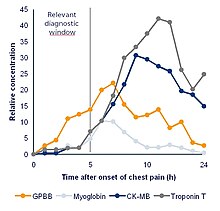
After a heart attack a number of different cardiac biomarkers can be measured to determine exactly when an attack occurred and how severe it was.
In medicine, a biomarker can be a traceable substance that is introduced into an organism as a means to examine organ function or other aspects of health. For example, rubidium chloride is used as a radioactive isotope to evaluate perfusion of heart muscle.
It can also be a substance whose detection indicates a particular disease state, for example, the presence of an antibody may indicate an infection. More specifically, a biomarker indicates a change in expression or state of a protein that correlates with the risk or progression of a disease, or with the susceptibility of the disease to a given treatment.
One example of a commonly used biomarker in medicine is prostate-specific antigen (PSA). This marker can be measured as a proxy of prostate size with rapid changes potentially indicating cancer. The most extreme case would be to detect mutant proteins as cancer specific biomarkers through Selected reaction monitoring (SRM), since mutant proteins can only come from an existing tumor, thus providing ultimately the best specificity for medical purposes.[2]
Biomarkers used for personalized medicine are typically categorized as either prognostic or predictive. An example is KRAS, an oncogene that encodes a GTPase involved in several signal transduction pathways. Prognostic biomarkers indicate the likelihood of patient outcome regardless of a specific treatment. Predictive biomarkers are used to help optimize ideal treatments, and indicates the likelihood of benefiting from a specific therapy. Biomarkers for precision oncology are typically utilized in the molecular diagnostics of chronic myeloid leukemia, colon, breast, and lung cancer, and in melanoma.[3]
Regulatory validation
Proof of concept
Previously used to identify the specific characteristics of the biomarker, this step is essential for doing an in situ validation of these benefits. A large number of candidates must be tested to select the most relevant ones.[4]
Experimental validation
This step allows the development of the most adapted protocol for routine use of the biomarker. Simultaneously, it is possible to confirm the relevance of the protocol with various methods (histology, PCR, ELISA, ...) and to define strata based on the results.
Analytical performances validation
One of the most important steps, it serves to identify specific characteristics of the candidate biomarker before developing a routine test. Several parameters are considered including:
- sensitivity
- specificity
- robustness
- accuracy
- reproducibility
Protocol standardization
This optimizes the validated protocol for routine use, including analysis of the critical points by scanning the entire procedure to identify and control the potential risks.
Cell biology
In cell biology, a biomarker is a molecule that allows the detection and isolation of a particular cell type (for example, the protein Oct-4 is used as a biomarker to identify embryonic stem cells).[5]
In genetics, a biomarker (identified as genetic marker) is a DNA sequence that causes disease or is associated with susceptibility to disease. They can be used to create genetic maps of whatever organism is being studied.
Geology and astrobiology
A biomarker can be any kind of molecule indicating the existence, past or present, of living organisms. In the fields of geology and astrobiology, biomarkers, versus geomarkers, are also known as biosignatures. The term biomarker is also used to describe biological involvement in the generation of petroleum.
Traumatic Brain Injury biomarkers
Please note this is about the text of this Wikipedia article; it should not be taken to reflect on the subject of this article.
Do not restore or edit the blanked content on this page until the issue is resolved by an administrator, copyright clerk or OTRS agent.
If you have just labeled this page as a potential copyright issue, please follow the instructions for filing at the bottom of the box.

The previous content of this page or section has been identified as posing a potential copyright issue, as a copy or modification of the text from the source(s) below, and is now listed on Wikipedia:Copyright problems :
Unless the copyright status of the text on this page is clarified, the problematic text or the entire page may be deleted one week after the time of its listing.
Temporarily, the original posting is still accessible for viewing in the page history.
- You must permit the use of your material under the terms of the Creative Commons Attribution-Sharealike 3.0 Unported License (CC-BY-SA) and the GNU Free Documentation License (GFDL) (unversioned, with no invariant sections, front-cover texts, or back-cover texts).
- Explain your intent to license the content on this article's discussion page
- To confirm your permission, you can either display a notice to this effect at the site of original publication or send an e-mail from an address associated with the original publication to permissions-en
 wikimedia.org or a postal letter to the Wikimedia Foundation. These messages must explicitly permit use under CC-BY-SA and the GFDL. See Wikipedia:Donating copyrighted materials.
 - Note that articles on Wikipedia must be written from a neutral point of view and must be verifiable in published third-party sources; consider whether, copyright issues aside, your text is appropriate for inclusion in Wikipedia.
 wikimedia.org
Explain this on this article's discussion page, with reference to evidence. Wikipedia:Public domain and Wikipedia:Compatibly licensed may assist in determining the status.
Your rewrite should be placed on this page, where it will be available for an administrator or clerk to review it at the end of the listing period. Follow this link to create the temporary subpage.
- Simply modifying copyrighted text is not sufficient to avoid copyright infringement—if the original copyright violation cannot be cleanly removed or the article reverted to a prior version, it is best to write the article from scratch. (See Wikipedia:Close paraphrasing.)
- For license compliance, any content used from the original article must be properly attributed; if you use content from the original, please leave a note at the top of your rewrite saying as much. You may duplicate non-infringing text that you had contributed yourself.
- It is always a good idea, if rewriting, to identify the point where the copyrighted content was imported to Wikipedia and to check to make sure that the contributor did not add content imported from other sources. When closing investigations, clerks and administrators may find other copyright problems than the one identified. If this material is in the proposed rewrite and cannot be easily removed, the rewrite may not be usable.
State that you have created a rewrite on this article's discussion page.
- Posting copyrighted material without the express permission of the copyright holder is unlawful and against Wikipedia policy.
- If you have express permission, this must be verified either by explicit release at the source or by e-mail or letter to the Wikimedia Foundation. See Wikipedia:Declaration of consent for all enquiries.
- Policy requires that we block those who repeatedly post copyrighted material without express permission.
If you have tagged the article for investigation, please complete the following steps:
- Add the following to the bottom of Wikipedia:Copyright_problems/2019 January 25
* subst:article-cv from https://www.researchgate.net/publication/322553718_An_update_on_diagnostic_and_prognostic_biomarkers_for_traumatic_brain_injury. ~~~~ - Place this notice on the talk page of the contributor of the copyrighted material:
pg=Biomarker ~~~~ - To blank a section instead of an entire article, add the template to the beginning of the section and Copyvio/bottom at the end of the portion you intend to blank.
The need for traumatic brain injury (TBI) biomarkers
Significant scientific advances in the last decade have increased our understanding of the complex and heterogeneous pathophysiological processes associated with traumatic brain injury [6]. During the same period, numerous experimental drugs have been shown to be neuroprotective in animal models of brain injury. Unfortunately, none of these strategies have proven to be efficacious in TBI clinical trials [13–15]. The failure of clinical therapy trials has been attributed to the lack of therapeutic intervention-tracking CNS biomarkers complicated by the heterogeneity of TBI and poor translatability of preclinical TBI models. For example, it is now recognized that the pathophysiology of TBI is not only acute event, but is also a progressive and delayed neurodegenerative process made up of multiple, parallel, interacting, and interdependent cascades of biological reactions at the tissue, cellular, and subcellular levels. Due to the extended length of axonal fiber tracks, axons are particularly vulnerable to physical trauma to the brain. Thus, axonal injury is a common occurrence in both focal as well as diffuse brain trauma and can be found in TBI of all severities [16,17]. But in addition, neuronal body, dendrites, and synapses are also subjected to TBI-induced damage [18,19]. Similarly, not only are neurons at risk for injury, but also astroglia cells and the myelin-forming oligodendrocytes. For these reasons, a comprehensive understanding of these pathobiological processes at every cellular and subcellular level in greater detail is critical to bridging the knowledge gap that will allow new therapy development. Many agree that there is an unmet medical need for a rapid, simple biofluid-based diagnostic testing for the management of TBI patients, whether it is for monitoring severe TBI patients in the intensive care unit, or triaging mild and moderate TBI patients in the emergency room. Due to the multicomponent pathobiology in brain injury, it would be ideal to have a panel of neuroinjury biomarkers that closely match with the various pathological processes we described above. There are emerging data from many recent studies from multiple research teams showing that biofluid-based TBI biomarker tests have the potential to assess the extent of TBI severity and determine a patient prognosis even at times when correlation with other neurological measures (neuroimaging) may not always be informative such as for mild TBI.[7]
TBI biomarker attributes
In order for a biofluid-based TBI protein biomarker to be clinically useful, ideally it should have as many of the following attributes as possible (Table 2): (1) The protein biomarker levels should be readily measured in accessible biofluid such as cerebrospinal fluid (CSF), serum, plasma, and/or whole blood in TBI patients. [For severe TBI (i.e. those TBI patients in neurointensive care unit), the biofluid type where the biomarker can be detected should be biofluids such as CSF, serum, plasma, and/or whole blood. For moderate and mild TBI (e.g. those patients managed in Emergency Departments or admitted to non-ICU settings), the biofluid type should be serum, plasma, and/or whole blood for rapid accessibility and convenience. (2) The biomarker levels must be elevated in various forms and/or severities of human TBI in the acute phase (3–24 h post-injury), when compared to normal control counterparts. (3) The biomarker must have low background or basal biofluid levels in general noninjured healthy control population. (4) The biomarker detected in biofluid after TBI should be derived from or originated from the injured brain as the major source. (5) The biomarker levels in the above stated biofluids should be readily determined and quantified using sandwich ELISA or similar immunoassays with at least two assay formats or platforms. (6) There should be one or more available assay platform for such biomarker with test-retest reliability and reproducibility assay that meet assay analytical performance requirements acceptable to FDA. (7) The biomarker should be translational in nature with demonstrated evidence that there are similar to biofluid profiles in at least two different animal models of TBI (e.g. rodent control cortical impact [CCI], fluid percussion injury [FPI], close head injury [CHI], penetrating ballistic brain injury [PBBI], or blast overpressure wave brain injury [OBI]). (8) The biomarker should be sensitive to severity of TBI as defined by GCS, CT abnormality. (9) The biomarker should allow for repeated detections in one of the above-mentioned biofluids within a 48 h window following brain injury. (10) The biomarker should have initial acute levels (within first 48 h post-injury) that correlate with currently available and commonly accepted TBI patient outcome indices (such as Glasgow Outcome Scale [GOS] or GOS-extended [GOS-E]). (11) The post-TBI biofluid levels of the biomarker are responsive to therapeutic treatments.Based on cumulative evidence on a number of existing neuroinjury biomarkers and the discovery of additional biomarkers, we derived a TBI biofluid-based biomarker panel .
Current biomarker candidates

Graphic representation of major TBI protein biomarkers linked to different pathophysiologic processes in TBI.
Mirroring the different pathophysiologic processes occurring in TBI, a panel of TBI biofluid-based protein biomarkers has now been identified. The processes covered by these biomarkers thus far include axonal injury, dendritic injury, neuronal cell body injury, demyelination, synaptic injury and astroglia injury, and microglia responses. Neuronal cell body injury markers include Neuron-specific enolase (NSE), Ubiquitin C-terminal hydrolase-L1 (UCH-L1), Astroglial biomarkers include S100B protein and glial fibrillary acidic protein (GFAP), There are also αII-spectrin breakdown products/fragments as cell death markers. Delayed axonal injury and demyelination markers include Neurofilament proteins (NF) – heavy, medium and light and Myelin basic protein (MBP). Subacute, chronic TBI biomarkers can include neuroinflammatory markers. Post-injury neurodegeneration/tauopathy such as Tau protein and phospho-tau protein. There are also autoantibodies as autoimmune response. They can target brain protein such as GFAP. Other biomarker candidates with biofluid evidence from animal models of TBI from severe to mTBI in human. These include dendritic protein microtubule-associated protein-2 (MAP-2) [137,138], brain-derived nerve growth factor (BDNF) [139], and postsynaptic protein neurogranin. Other emerging biomarkers include MicroRNA (miRNA), Circulating nucleic acids, and Exosome/micro-vesicles biomarkers.
Temporal protein biomarkers in tracking different phases of TBI

A continuum of protein biomarkers in tracking different phases of TBI
TBI biomarkers might be detected in biofluid (such as blood or CSF) in different post-injury time. See graph.
Ecotoxicology
Biomarkers are used to indicate an exposure to or the effect of xenobiotics which are present in the environment and in organisms. The biomarker may be an external substance itself (e.g. asbestos particles or NNK from tobacco), or a variant of the external substance processed by the body (a metabolite) that usually can be quantified.
History
The widespread use of the term "biomarker" dates back to as early as 1980.[8] The term "biological marker" was introduced in 1950s.[9][10] In 1998, the National Institutes of Health Biomarkers Definitions Working Group defined a biomarker as "a characteristic that is objectively measured and evaluated as an indicator of normal biological processes, pathogenic processes, or pharmacologic responses to a therapeutic intervention."[11][12]
See also
- Bioindicator
- Biomarker discovery
Biomarkers (journal)
Biomarker Insights – a journal- Imaging biomarker
- Endophenotype
- Molecular marker
- Saliva testing
- Sponge biomarkers
References
^ Biomarkers Definitions Working Group (March 2001). "Biomarkers and surrogate endpoints: preferred definitions and conceptual framework". Clin. Pharmacol. Ther. (Review). 69 (3): 89–95. doi:10.1067/mcp.2001.113989. PMID 11240971..mw-parser-output cite.citationfont-style:inherit.mw-parser-output .citation qquotes:"""""""'""'".mw-parser-output .citation .cs1-lock-free abackground:url("//upload.wikimedia.org/wikipedia/commons/thumb/6/65/Lock-green.svg/9px-Lock-green.svg.png")no-repeat;background-position:right .1em center.mw-parser-output .citation .cs1-lock-limited a,.mw-parser-output .citation .cs1-lock-registration abackground:url("//upload.wikimedia.org/wikipedia/commons/thumb/d/d6/Lock-gray-alt-2.svg/9px-Lock-gray-alt-2.svg.png")no-repeat;background-position:right .1em center.mw-parser-output .citation .cs1-lock-subscription abackground:url("//upload.wikimedia.org/wikipedia/commons/thumb/a/aa/Lock-red-alt-2.svg/9px-Lock-red-alt-2.svg.png")no-repeat;background-position:right .1em center.mw-parser-output .cs1-subscription,.mw-parser-output .cs1-registrationcolor:#555.mw-parser-output .cs1-subscription span,.mw-parser-output .cs1-registration spanborder-bottom:1px dotted;cursor:help.mw-parser-output .cs1-ws-icon abackground:url("//upload.wikimedia.org/wikipedia/commons/thumb/4/4c/Wikisource-logo.svg/12px-Wikisource-logo.svg.png")no-repeat;background-position:right .1em center.mw-parser-output code.cs1-codecolor:inherit;background:inherit;border:inherit;padding:inherit.mw-parser-output .cs1-hidden-errordisplay:none;font-size:100%.mw-parser-output .cs1-visible-errorfont-size:100%.mw-parser-output .cs1-maintdisplay:none;color:#33aa33;margin-left:0.3em.mw-parser-output .cs1-subscription,.mw-parser-output .cs1-registration,.mw-parser-output .cs1-formatfont-size:95%.mw-parser-output .cs1-kern-left,.mw-parser-output .cs1-kern-wl-leftpadding-left:0.2em.mw-parser-output .cs1-kern-right,.mw-parser-output .cs1-kern-wl-rightpadding-right:0.2em as cited in Siderowf A, Aarsland D, Mollenhauer B, Goldman JG, Ravina B (April 2018). "Biomarkers for cognitive impairment in Lewy body disorders: Status and relevance for clinical trials". Mov. Disord. (Review). 33 (4): 528–36. doi:10.1002/mds.27355. PMID 29624752.
^ Wang, Qing; Raghothama Chaerkady (December 2010). "Mutant proteins as cancer-specific biomarkers". Proceedings of the National Academy of Sciences. 108 (6): 2444–2449. doi:10.1073/pnas.1019203108. PMC 3038743. PMID 21248225.
^ Nalejska, Ewelina (2014). "Prognostic and Predictive Biomarkers". Molecular Oncology and Genetics. 18 (3): 273–284. doi:10.1007/s40291-013-0077-9. PMC 4031398. PMID 24385403.
^ "Proof-of-concept study of biomarker development in mice provides a roadmap for a similar approach in humans". www.fredhutch.org. 2011-07-19. Retrieved 2015-05-13.
^ Biomarkers for Psychiatric Disorders. Publisher: Springer U.S. doi:10.1007/978-0-387-79251-4
Copyright: 2009
ISBN 978-0-387-79250-7 (Print) 978-0-387-79251-4 (Online)
^ Neurotrauma : a comprehensive textbook on traumatic brain injury and spinal cord injury. Wang, Kevin K. W. New York: Oxford University Press. 2019. ISBN 0190279435. OCLC 1048935009.
^ Wang, Kevin K.; Yang, Zhihui; Zhu, Tian; Shi, Yuan; Rubenstein, Richard; Tyndall, J. Adrian; Manley, Geoff T. (February 2018). "An update on diagnostic and prognostic biomarkers for traumatic brain injury". Expert Review of Molecular Diagnostics. 18 (2): 165–180. doi:10.1080/14737159.2018.1428089. ISSN 1744-8352. PMID 29338452.
^ Aronson, Jeffrey (2005). "Biomarkers and surrogate endpoints". British Journal of Clinical Pharmacology. 59 (5): 491–494. doi:10.1111/j.1365-2125.2005.02435.x. PMC 1884846. PMID 15842546.
^ Porter, K. A. (1957-08-01). "Effect of homologous bone marrow injections in x-irradiated rabbits". British Journal of Experimental Pathology. 38 (4): 401–412. ISSN 0007-1021. PMC 2082598. PMID 13460185.
^ Basu, P. K.; Miller, I.; Ormsby, H. L. (1960-03-01). "Sex chromatin as a biologic cell marker in the study of the fate of corneal transplants". American Journal of Ophthalmology. 49 (3): 513–515. doi:10.1016/0002-9394(60)91653-6. ISSN 0002-9394. PMID 13797463.
^ Strimbu, Kyle; Jorge, Tavel (2010). "What are Biomarkers?". Current Opinion in HIV and AIDS. 5 (6): 463–466. doi:10.1097/COH.0b013e32833ed177. PMC 3078627. PMID 20978388.
^ "Biomarkers and surrogate endpoints: preferred definitions and conceptual framework". Clinical Pharmacology & Therapeutics. 69 (3): 89–95. 2001. doi:10.1067/mcp.2001.113989. PMID 11240971.
 | Look up biomarker in Wiktionary, the free dictionary. |
 | Scholia has a topic profile for Biomarker. |

