California Democratic Party
California Democratic Party | |
|---|---|
 | |
| Chairperson | Alex Gallardo-Rooker (acting) |
| Senate leadership | Toni Atkins (President pro tempore) |
| Assembly leadership | Anthony Rendon (Speaker) |
| Governor of California | Gavin Newsom |
| Lieutenant Governor of California | Eleni Kounalakis |
| Founded | 1846 (1846) |
| Headquarters | 1830 9th Street, Sacramento CA 95811 |
| Ideology | Modern liberalism Progressivism Social liberalism |
| Political position | Center-left to left-wing |
| National affiliation | U.S. Democratic Party |
| Colors | Blue |
| Seats in the U.S. Senate | 2 / 2 |
| Seats in the U.S. House | 46 / 53 |
Statewide Executive Offices1 | 8 / 8 |
| Seats in the State Senate | 29 / 40 |
| Seats in the State Assembly | 61 / 80 |
| Website | |
| www.cadem.org | |
1California Department of Education is a nonpartisan state executive position. | |
The California Democratic Party is the state branch of the United States Democratic Party in the state of California. The party is headquartered in Sacramento, and is led by acting-Chair Alex Gallardo-Rooker.[1]
With 43.5% of the state's registered voters as of 2018, the Democratic Party has the highest number of registrants of any political party in California.[2] The party also enjoys supermajorities in both houses of the California State Legislature, holding 61 out of 80 seats in the California State Assembly and 29 out of 40 in the California State Senate. It holds all 8 statewide executive branch offices, 46 of the state's 53 seats in the House of Representatives, and both of California's seats in the United States Senate.
Contents
1 History
1.1 Early history
1.2 1990s
1.3 1994
1.4 1996
1.5 1998
1.6 2002
1.7 2010
1.8 2012
2 Governance
2.1 County central committees
2.2 List of chairs
3 Organization
3.1 Platform
3.2 Resolutions
4 Current elected officials
4.1 Statewide constitutional officers
4.2 Federal officeholders for the 116th United States Congress
4.2.1 U.S. Senate
4.2.2 U.S. House of Representatives
4.3 Board of Equalization, State Senate, & State Assembly
4.3.1 Board of Equalization
4.3.2 State Senate
4.3.3 State Assembly
4.4 Mayoral offices
5 References
6 See also
7 External links
History
The history of the Democratic Party of California is complex and long. The State has traded hands every few cycles since its admission into the union in 1850. At that time, the state was firmly in the hands of the Democratic Party.
Early history
Until the early 1880s after the Republican Party abolished slavery, the Republicans held the state through the power and influence of railroad men. The Democratic Party responded by taking an anti-corporate, anti freedom of attainment position. In 1894, Democrat James Budd was elected to the governorship, and the Democratic Party attempted to make good on their promises to reform the booming railroad industry. The party began working closely with the state's railroad commission to create fair rates for passengers and to eliminate monopolies the railroad companies held over the state. The main effort focused on making railroads public avenues of transportation similar to streets and roads. This measure passed and was a great victory for the Democrats, but the honeymoon would not last.[3] Budd was to be the last Democratic governor for thirty years. The struggle between the anti-monopolists and the railroad companies was, however, a key and defining issue for the Democratic Party for some time.
Despite their relative lack of power during this period, the Democrats in California were still active in pursuing reform. The party supported fairer railroad policies and crusaded for tariff reform.[3] The party also supported the large scale railroad strikes that sprung up statewide. The corruption of the time in both the railroad companies and the government led to a change in political dynamic. The people of the state moved away from both of the main parties and the Progressive Movement began.
While the Progressives were successful in creating positive reform and chasing out corruption, the movement drained away many of the Democratic Party's members. As their movement ended, the Republicans won the governorship, but the Democratic Party had a distinct voter advantage.
In 1932, Franklin D. Roosevelt was elected president and the Power balance between the Republicans and the Democrats in California equalized. However, as Roosevelt's New Deal policies began to raise the nation out of the depression, Democratic strength mounted. Culbert Olson was elected to the governorship, but his term was rocky and both parties organized against him. Shortly thereafter, Earl Warren and the Republicans seized power again.[4]
The California Democratic Party needed a new strategy to regain power in the state. A strategy of reorganization and popular mobilization emerged and resulted in the creation of the California Democratic Council. The CDC as it became known was a way for members of the party from all levels of government to come together and as such the party became more unified. A new network of politically minded civilians and elected officials emerged and the party was stronger for it.[5] Despite the fact that the council struggled in the cold war era, due to Republican strength and issues such as the Vietnam War, it still exists today.[6]
1990s
By 1992, California was hurting more than most states from a national recession which had started in 1990, causing incumbent Republican President George H.W. Bush's approval rating to tank within the state, giving an opening for the Democratic party to break through and eventually become the largest party. Starting with the double digit victory of Bill Clinton, this became the first time a Democrat had carried the state of California since 1964. Afterwards, a consolidation of the Latino and Asian vote would strengthen the Democratic party's hold in California, when these groups had previously been considered core Republican supporters within the state.
The California Democratic Party began re-organizing in 1991, and in 1992 the party won the greatest victories in the history of California. President Clinton won California's 54 electoral votes and two women, Dianne Feinstein and Barbara Boxer, were elected as U.S. senators.
Even though redistricting (reapportionment) was executed by a Republican State Supreme Court, California Democrats in November 1992 had increased their margin at all levels—Congressional, State Assembly and in the State Senate.
1994
In 1994, California Democrats suffered a setback by losing the governor's race for the fourth time in a row, and the Democrats became a minority in the State Assembly. However, despite $29 million spent by Republican U.S. Senate candidate Michael Huffington, Democratic incumbent U.S. Senator Dianne Feinstein won re-election.
1996
The 1996 elections proved to be a dramatic turnaround from the results of 1994, as President Bill Clinton won California's 54 electoral votes for a second consecutive time. Three Republican Congressman were also defeated, including Bob Dornan in the conservative stronghold of Orange County. In addition, California Democrats also regained the majority in the State Assembly while adding to their majority in the State Senate.
1998
1998 was a banner year for California Democrats. An overwhelming majority of Californians elected Gray Davis, the first Democratic Governor in 16 years and re-elected U.S. Senator Barbara Boxer. Six of eight candidates for statewide constitutional offices won including Lieutenant Governor Cruz Bustamante, Attorney General Bill Lockyer, Treasurer Phil Angelides, Controller Kathleen Connell and State Superintendent of Public Instruction Delaine Eastin. In addition, California Democrats increased their majority in the State Assembly from 43 to 48 and also in the State Senate from 23 to 25.
2002
Holding off a national Republican trend in 2002, California Democrats won all eight statewide offices for the first time since 1882. Governor Gray Davis, Lieutenant Governor Cruz Bustamante, Attorney General Bill Lockyer and State Treasurer Phil Angelides were all re-elected while Steve Westly was elected State Controller, Kevin Shelley was elected Secretary of State, John Garamendi was elected Insurance Commissioner and Jack O'Connell was elected State Superintendent of Public Instruction.
2010
This feat (winning all statewide offices) was repeated in 2010, when, despite massive Republican gains nationwide, the California Democratic Party swept all the statewide offices being contested, maintained its 34-19 edge in the 53-member U.S. House delegation and won one additional seat (thus increasing their majority) in the State Assembly while maintaining their current majority in the State Senate.
2012
In the 2012 election, California Democrats experienced tremendous success once again: not only did President Barack Obama win California's 55 electoral votes again with over 60% of the vote and Senator Dianne Feinstein reelected with over 62% of the vote, but California Democrats - despite running in federal and legislative districts that were redrawn by an independent redistricting commission for the first time, per the passage of Propositions 11 and 20, and the implementation of a new blanket primary - also won a net gain of four House seats by defeating three GOP incumbents and winning an open GOP seat and won a supermajority in both houses of the state legislature, a feat which the party last accomplished in 1882.[7] Geographically, the 2012 elections also witnessed the California Democratic Party make inroads in traditionally Republican areas: San Diego, the second largest city in California and a longtime GOP stronghold, elected a Democratic mayor for the first time since 1988.[8] California Democrats also notched up victories in other traditionally Republican areas such as the Inland Empire, Ventura County, the Central Valley, and Orange County.[9]
Governance
The California Democratic Party is a "political party that has detailed statutory provisions applicable to its operation", which are in division 7, part 2 of the California Elections Code.[10][11][12] The Democratic State Central Committee, which is the governing body of the California Democratic Party, functions pursuant to its standing rules and bylaws.[13][14] The Democratic State Central Committee is composed of approximately 2,900 members that are appointed by Democratic elected officials and nominees, elected by county central committees, and elected in Assembly district election meetings, in roughly equal proportion.[15] The Executive Board is composed of approximately 320 members and holds all powers and duties of the California Democratic Party while the state central committee or its conventions are not in session.[15][16]
There are semi-autonomous county central committees for each of California's 54 counties. Each county central committee elects 4 members, plus a member for each 10,000 registered Democrats in that county, to the state central committee.[15][17] The state central committee bylaws specify that county central committees may provide for the election of their allocation of membership on an at-large basis, or by county supervisor districts or Assembly districts, or by any combination thereof.[18]
"Assembly district election meetings" are held biennially in January in every odd-numbered year (immediately after elections for the Governor and President) within each of California's 80 Assembly districts.[15][19] Participation is open to all registered Democrats within the Assembly district.[20] Each meeting elects 12 members to the state central committee, divided as equally as possible between men and women.[21]
County central committees
At every direct primary election, a county central committee is elected in each county.[22] The California Elections Code specifies how county central committee members are elected.[23] Candidates for county central committees are nominated pursuant to division 8, part 1, chapter 1 of the Elections Code,[24] which defines requirements such as the number of Democratic registered voters required (20-40) to sign a nomination.[25][26] A county central committee may also select its members at any time by holding a caucus or convention or by using any other method of selection approved by the committee.[27] If the number of candidates nominated for election does not exceed the number of candidates to be elected, the candidates are not listed on the ballots, but are instead declared elected by the Board of Supervisors.[28]
| County party | Elected members |
|---|---|
Los Angeles County Democratic Party | There are 7 county central committee members elected at-large by Democratic voters in each California State Assembly district contained wholly or partially within Los Angeles County.[29][30] |
San Diego County Democratic Party | There are 6 county central committee members elected by Democratic voters in each California State Assembly district contained within San Diego County.[31][32] |
Orange County Democratic Party | There are 6 county central committee members elected by Democratic voters in each California State Assembly district contained within Orange County at the primary election in each even numbered year.[31][33][34] |
Santa Clara County Democratic Party | There are 6 county central committee members elected by Democratic voters in each California State Assembly district contained within Santa Clara County.[31][35][36] |
Alameda County Democratic Party | There are 6 county central committee members elected by Democratic voters in each California State Assembly district contained within Alameda County.[31][37] |
Sacramento County Democratic Party | There are 6 county central committee members elected by Democratic voters in each supervisor district in Sacramento County.[38] |
San Francisco Democratic Party | The 24-member county central committee is elected from the two Assembly districts in San Francisco, with a 14/10 member split between the two Assembly districts based on number of registered Democrats.[39][40] |
San Mateo County Democratic Party | There are 22 elected members of the San Mateo County Democratic Central Committee. They are elected by democratic voters in each County Supervisor District every four years in the Presidential election cycle.[41] |
List of chairs
George T. Marye (1888-93)
William Hays Alford 1896
Seth Mann (1898-1900)
John E. Raker (1908-10)
Claude F. Purkitt (1922-28)
Harry H. McPike (1929-30)
Zachary T. Malaby 1931
Clifford C. Anglim 1937
Paul Peek 1939
Culbert L. Olson 1944-46
William M. Malone 1945
Oliver Carter 1949
Glenn M. Anderson 1950-52
Elizabeth C. Snyder 1955
Roger Kent 1958
Charles Manatt 1971-73
John L. Burton 1973-74
Charles Taylor Manatt (early 1970s–1981)
Nancy Pelosi (1981–1983)- Peter D. Kelly III (1983–1985)[42]
- Betty Smith (1985–1987)[42]
- Peter D. Kelly III (1987–1989)[43]
Jerry Brown (1989–1991)[44]
Phil Angelides (1991–1993)[44]
Bill Press (1993–1996)[45]
Art Torres (1996–2009)[46]
John Burton (2009–2017)
Eric C. Bauman (2017–2018)- Alex Gallardo-Rooker (acting, 2018-present)
Organization
The Democratic State Central Committee of the California Democratic Party of California is organized into nine standing committees: Platform, Resolutions, Rules, Legislation, Affirmative Action, Credentials, Finance, Organizational Development, and Voter Services.[47]
Platform
The California Democratic Party of California adopted its new platform on 12 February 2012.[48] This platform covers a wide range of topics and issues under the following headings:
- Blueprint for the Golden State
- Business and Economy
- Civil Justice
- Criminal Justice
- Culture and the Arts
- Death with Dignity
- Disabilities
- Education
- Energy & Environment
- Equality of Opportunity
- Freedom of Speech, Communications, and the Internet
|
In regards to businesses and economics, the California Democratic party takes a stance that protects consumers, small businesses, unions, and individuals whose homes have been foreclosed upon. The platform also makes a point to champion the economic reforms of President Barack Obama.
The 2012 platform addresses the issues of family in several sections. The platform promises to protect seniors, children and all types of families with fair economic and social policies. These policies range from continuing Medicare for the elderly and keeping playgrounds safe for children. The platform also highlights the right of a woman to make choices for her own body and claims that healthcare is a natural right of all people. The California democrats further promise to protect the dignity of disabled citizens. The platform is dedicated to advocating for the rights of women through equal pay and affirmative action.
The party prioritizes the creation of a sustainable and earth-friendly state. Focus is placed on the development of alternative forms of energy and how energy is consumed. In addition, the platform stresses that green jobs are a solution to economic and environmental concerns.
Finally, the platform takes stances on open internet use, immigration, and education. The Democrats of California support the right of the people to express their thoughts and ideas through any media, and their right to assemble. The party believes that immigration laws should be fair and that immigrants should not be discriminated against. The party wishes to bring education to the forefront, aiming to turn California into a leading state for academic achievement.
A Detailed description of the California Democratic Party's position on all of the above issues can be found in their 2012 Platform document .
Resolutions
The California Democratic Party passes multiple resolutions every year as a way of expressing their opinion to lawmakers statewide. While the party's resolutions have no legal force themselves, they are official documents that elected representatives should take into account when making decisions. A few recent resolutions are summarised below:
- 2012 Buy American
- This resolution, written 18 November 2012, encourages all arms of government to favor American suppliers of goods and services.
- 2012 Department of Defense Clean Energy Initiatives
- This resolution was written on 18 November 2012 and supports the Department of Defense's initiative to commit to clean energy and alternative fuels through the Navy's "Great Green Fleet" initiative, the Army's "Net Zero" initiative, and the Air Force's commitment to lower carbon emissions.
- 2012 Filibuster Reform
- This resolution condemns the Republican Party's use of the filibuster to disrupt the work of the U.S. Senate and advocates that reform must be the first priority of the Senate Majority.
The above are only three of a long list of Resolutions passed by the California Democratic Party. For a full list and details of all Resolutions, refer to the official website.[49]
Current elected officials
The following is a list of Democratic statewide, federal, and legislative officeholders as of January 3, 2013:
Statewide constitutional officers
After the last election, Democrats maintained control over all eight elected statewide constitutional offices:
- Governor: Gavin Newsom
- Lieutenant Governor: Eleni Kounalakis
- Secretary of State: Alex Padilla
- State Controller: Betty Yee
- State Treasurer: Fiona Ma
- Attorney General: Xavier Becerra
- Insurance Commissioner: Ricardo Lara
- Superintendent of Public Instruction: Tony Thurmond (this office is officially non-partisan and Thurmond was elected as a non-partisan)
Federal officeholders for the 116th United States Congress
U.S. Senate
Both of California's seats in the U.S. Senate have been under Democratic control since 1992:
- Class I: Dianne Feinstein (Senior Senator)
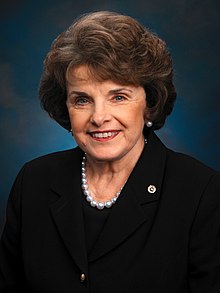
Senior Senator Feinstein - Class III: Kamala Harris (Junior Senator)

Junior Senator Harris

U.S. House of Representatives
Of the 53 seats California is apportioned in the U.S. House following the 2010 census, 46 are held by Democrats:

Speaker Pelosi
CA-02: Jared Huffman
CA-03: John Garamendi
CA-05: Mike Thompson
CA-06: Doris Matsui
CA-07: Ami Bera
CA-09: Jerry McNerney
CA-10: Josh Harder
CA-11: Mark DeSaulnier
CA-12: Nancy Pelosi (Speaker of the House)[50]
CA-13: Barbara Lee
CA-14: Jackie Speier
CA-15: Eric Swalwell
CA-16: Jim Costa
CA-17: Ro Khanna
CA-18: Anna Eshoo
CA-19: Zoe Lofgren
CA-20: Jimmy Panetta
CA-21: TJ Cox
CA-24: Salud Carbajal
CA-25: Katie Hill
CA-26: Julia Brownley
CA-27: Judy Chu
CA-28: Adam Schiff
CA-29: Tony Cardenas
CA-30: Brad Sherman
CA-31: Pete Aguilar
CA-32: Grace Napolitano
CA-33: Ted Lieu
CA-34: Jimmy Gomez
CA-35: Norma Torres
CA-36: Raul Ruiz
CA-37: Karen Bass
CA-38: Linda Sánchez
CA-39: Gil Cisneros
CA-40: Lucille Roybal-Allard
CA-41: Mark Takano
CA-43: Maxine Waters
CA-44: Nanette Barragán
CA-45: Katie Porter
CA-46: Lou Correa
CA-47: Alan Lowenthal
CA-48: Harley Rouda
CA-49: Mike Levin
CA-51: Juan Vargas
CA-52: Scott Peters
CA-53: Susan Davis
Board of Equalization, State Senate, & State Assembly
Board of Equalization
Democrats hold four of the five seats on the State Board of Equalization: three of the four district-based seats, and the at-large ex officio seat reserved for the incumbent State Controller, who in this instance is Democrat Betty Yee.
- 2nd District: Malia Cohen
- 3rd District: Tony Vasquez
- 4th District: Mike Schaefer
- State Controller: Betty Yee
State Senate
Democrats hold a 29-11 supermajority in the 40-member California State Senate. The Democrats have been the majority party in the Senate continuously since 1956.
SD 2: Mike McGuire (Majority Caucus Vice Chair)
SD 3: Bill Dodd
SD 5: Cathleen Galgiani
SD 6: Richard Pan
SD 7: Steve Glazer
SD 9: Nancy Skinner
SD 10: Bob Wieckowski
SD 11: Scott Wiener
SD 12: Anna Caballero
SD 13: Jerry Hill
SD 14: Melissa Hurtado
SD 15: Jim Beall
SD 17: Bill Monning (Majority Leader)
SD 18: Robert Hertzberg
SD 19: Hannah-Beth Jackson
SD 20: Connie Leyva (Majority Caucus Chair)
SD 22: Susan Rubio
SD 24: Maria Elena Durazo
SD 25: Anthony Portantino
SD 26: Ben Allen
SD 27: Henry Stern
SD 30: Holly Mitchell
SD 31: Richard Roth
SD 32: Bob Archuleta
SD 33: Vacant (previously held by Lara)
SD 34: Tom Umberg
SD 35: Steven Bradford
SD 39: Toni Atkins (Senate President pro Tempore)
SD 40: Ben Hueso
State Assembly
Democrats hold a 61–19 supermajority in the 80-seat California State Assembly. The Democrats have been the majority party in the Assembly continuously since 1996.
AD 2: Jim Wood
AD 4: Cecilia Aguiar-Curry
AD 7: Kevin McCarty
AD 8: Ken Cooley
AD 9: Jim Cooper (Assistant Majority Leader)
AD 10: Marc Levine
AD 11: Jim Frazier
AD 13: Susan Eggman
AD 14: Tim Grayson
AD 15: Buffy Wicks
AD 16: Rebecca Bauer-Kahan
AD 17: David Chiu (Assistant Speaker pro tempore)
AD 18: Rob Bonta
AD 19: Phil Ting
AD 20: Bill Quirk
AD 21: Adam Gray
AD 22: Kevin Mullin (Speaker pro tempore)
AD 24: Marc Berman
AD 25: Kansen Chu
AD 27: Ash Kalra
AD 28: Evan Low (Assistant Majority Whip)
AD 29: Mark Stone
AD 30: Robert Rivas
AD 31: Joaquin Arambula
AD 32: Rudy Salas
AD 37: Monique Limón
AD 38: Christy Smith
AD 39: Luz Rivas
AD 40: James Ramos
AD 41: Chris Holden
AD 43: Laura Friedman
AD 44: Jacqui Irwin
AD 45: Jesse Gabriel
AD 46: Adrin Nazarian
AD 47: Eloise Reyes
AD 48: Blanca Rubio
AD 49: Ed Chau
AD 50: Richard Bloom
AD 51: Wendy Carrillo
AD 52: Freddie Rodriguez
AD 53: Miguel Santiago (Majority Whip)
AD 54: Sydney Kamlager
AD 56: Eduardo Garcia
AD 57: Ian Calderon (Majority Leader)
AD 58: Cristina Garcia
AD 59: Reggie Jones-Sawyer
AD 60: Sabrina Cervantes
AD 61: Jose Medina
AD 62: Autumn Burke (Assistant Speaker pro tempore)
AD 63: Anthony Rendon (Speaker of the Assembly)
AD 64: Mike Gipson (Majority Caucus Chair)
AD 65: Sharon Quirk-Silva
AD 66: Al Muratsuchi
AD 69: Tom Daly
AD 70: Patrick O'Donnell
AD 74: Cottie Petrie-Norris
AD 76: Tasha Boerner Horvath
AD 77: Brian Maienschein
AD 78: Todd Gloria
AD 79: Shirley Weber
AD 80: Lorena Gonzalez Fletcher
Mayoral offices
Some of the state's major cities have Democratic mayors. As of 2019, Democrats control the mayor's offices in six of California's ten largest cities:
Los Angeles (1): Eric Garcetti
San Jose (3): Sam Liccardo
San Francisco (4): London Breed
Sacramento (6): Darrell Steinberg
Long Beach (7): Robert Garcia
Oakland (8): Libby Schaaf
References
^ "Contact Us Archived 2010-05-28 at the Wayback Machine." California Democratic Party. Retrieved on May 13, 2010.
^ California Secretary of State Report of Registration as of October 22, 2018
^ ab Williams Hal, "The Democratic Party and California Politics 1880 - 1896" (Stanford University Press, California, 1973)
^ http://www.kintera.org/site/pp.asp?c=fvLRK7O3E&b=33602
^ Bell Jonathan, "Social Democracy and the Rise of the Democratic Party in California 1950 - 1964" (The Historical Journal)
^ "California Democratic Council - California Democratic Council". www.cdc-ca.org. Retrieved 25 March 2018..mw-parser-output cite.citationfont-style:inherit.mw-parser-output .citation qquotes:"""""""'""'".mw-parser-output .citation .cs1-lock-free abackground:url("//upload.wikimedia.org/wikipedia/commons/thumb/6/65/Lock-green.svg/9px-Lock-green.svg.png")no-repeat;background-position:right .1em center.mw-parser-output .citation .cs1-lock-limited a,.mw-parser-output .citation .cs1-lock-registration abackground:url("//upload.wikimedia.org/wikipedia/commons/thumb/d/d6/Lock-gray-alt-2.svg/9px-Lock-gray-alt-2.svg.png")no-repeat;background-position:right .1em center.mw-parser-output .citation .cs1-lock-subscription abackground:url("//upload.wikimedia.org/wikipedia/commons/thumb/a/aa/Lock-red-alt-2.svg/9px-Lock-red-alt-2.svg.png")no-repeat;background-position:right .1em center.mw-parser-output .cs1-subscription,.mw-parser-output .cs1-registrationcolor:#555.mw-parser-output .cs1-subscription span,.mw-parser-output .cs1-registration spanborder-bottom:1px dotted;cursor:help.mw-parser-output .cs1-ws-icon abackground:url("//upload.wikimedia.org/wikipedia/commons/thumb/4/4c/Wikisource-logo.svg/12px-Wikisource-logo.svg.png")no-repeat;background-position:right .1em center.mw-parser-output code.cs1-codecolor:inherit;background:inherit;border:inherit;padding:inherit.mw-parser-output .cs1-hidden-errordisplay:none;font-size:100%.mw-parser-output .cs1-visible-errorfont-size:100%.mw-parser-output .cs1-maintdisplay:none;color:#33aa33;margin-left:0.3em.mw-parser-output .cs1-subscription,.mw-parser-output .cs1-registration,.mw-parser-output .cs1-formatfont-size:95%.mw-parser-output .cs1-kern-left,.mw-parser-output .cs1-kern-wl-leftpadding-left:0.2em.mw-parser-output .cs1-kern-right,.mw-parser-output .cs1-kern-wl-rightpadding-right:0.2em
^ Onishi, Norimitsu (9 November 2012). "Democrats Likely to Win Supermajority in California Legislature". Retrieved 25 March 2018 – via NYTimes.com.
^ "Home". sandiego6.com. Retrieved 25 March 2018.
^ http://www.sacbee.com/2012/11/23/5005280/dan-walters-californias-gop-fishhook.html#mi_rss=Top%20Stories
^ California Elections Code § 7050
^ West's California Jurisprudence 3d. 28. Bancroft-Whitney Company. 1972. p. 615. OCLC 605100.The organization, operation, and functions of the Democratic Party of California are specifically regulated by the Elections Code.
^ Eu v. San Francisco County Democratic Central Committee (1989), 489 U.S. 214 Archived 2014-03-12 at the Wayback Machine. "The State of California heavily regulates its political parties. … The California Elections Code (Code) provides that the 'official governing bodies' for such a party are its 'state convention,' 'state central committee,' and 'county central committees,' …"
^ California Elections Code § 7150
^ By-Laws & Rules of the California Democratic Party Archived 2013-05-13 at the Wayback Machine. July 2012.
^ abcd "About Us / California Democratic Party". California Democratic Party. Archived from the original on 13 May 2013. Retrieved 30 May 2013.
^ By-Laws Article VII, § 1(a)
^ By-Laws Article II, § 4(a)
^ By-Laws Article II, § 4(f)
^ By-Laws Article VI, § 1(a)(1)
^ By-Laws Article VI, § 1(a)(2)
^ By-Laws Article II, § 1(a)(4), § 5(a), § 5(b)
^ California Elections Code § 7225 et seq.
^ California Elections Code §§ 7200–7216
^ California Elections Code § 7227
^ California Elections Code § 8062
^ California Elections Code § 8068
^ California Elections Code § 7230
^ California Elections Code § 7228
^ California Elections Code § 7203
^ Constitution and By-Laws of the Los Angeles County Democratic Central Committee, 10 April 2012, p. 2
^ abcd California Elections Code § 7202
^ San Diego County Democratic Party Bylaws Archived 2014-03-09 at the Wayback Machine, 20 November 2012, Article 2, § 1(B)(2)
^ "Central Committee - Democratic Party of Orange County". Retrieved 8 March 2014.
^ Orange County Democratic Central Committee Bylaws, August 2009, Article II, § 1(A)
^ "Central Committee - Santa Clara County Democratic Party". Retrieved 8 March 2014.
^ Santa Clara County Democratic Central Committee By-Laws, § II.A.1.
^ Bylaws of the Alameda County Democratic Central Committee, August 7, 2013, Article II, § 2
^ Sacramento County Democratic Central Committee Constitution Archived 2014-03-09 at the Wayback Machine, March 2013, Article II, § 1(B)(1)
^ California Elections Code § 7204
^ San Francisco Democratic County Central Committee Bylaws[permanent dead link], 23 January 2013, Article 2, § 1(a)(1)
^ "About Us". smcdems.org. Retrieved 25 March 2018.
^ ab "The State". Los Angeles Times. 1987-02-02. ISSN 0458-3035. Retrieved 2019-01-12.
^ Times, Special to the New York (1989-02-13). "Jerry Brown Wins State Party Post". The New York Times. ISSN 0362-4331. Retrieved 2019-01-12.
^ ab STALL, BILL (1993-09-04). "Angelides Outlines Plans in Treasurer Bid". Los Angeles Times. ISSN 0458-3035. Retrieved 2019-01-12.
^ Press, Bill (2018-03-20). From the Left: A Life in the Crossfire. St. Martin's Press. ISBN 9781250147165.
^ Orlov, Rick (2008-04-01). "Lining up to follow Art Torres". The Sausage Factory. Retrieved 2019-01-12.
^ Standing Committees
^ California Democratic Party Official Website Archived 2010-12-06 at the Wayback Machine
^ California Democratic Party Resolutions Archived 2013-03-16 at the Wayback Machine
^ https://www.vox.com/2019/1/3/18166742/nancy-pelosi-speaker-house-democrats-congress
See also
 California Democratic Party portal
- Democratic Party (United States) organizations
- List of state parties of the Democratic Party (United_States)
- Political party strength in California
 California Democratic Party portal
External links
- California Democratic Party portal
- California Democratic Party
- California State Assembly Democratic Caucus
California political parties | ||
|---|---|---|
| Major parties (ballot-qualified) |
|  |
| Minor parties (ballot-qualified) |
| |
| Minor parties (not ballot-qualified) |
| |
Political party strength in California | ||
United States Democratic Party | |||||||
|---|---|---|---|---|---|---|---|
| Chairpersons of the DNC |
| ||||||
| Presidential tickets |
| ||||||
| State and Territorial Parties |
| ||||||
Conventions (List) |
| ||||||
| Affiliated groups |
| ||||||
| Related articles |
| ||||||
| |||||||