Septum
 | Look up septum in Wiktionary, the free dictionary. |
In biology, a septum (Latin for something that encloses; plural septa) is a wall, dividing a cavity or structure into smaller ones.
Contents
1 Examples
1.1 Human anatomy
1.2 Cell biology
1.3 Fungus
1.4 Botany
1.5 Zoology
1.6 Laboratory technology
Examples
Human anatomy
Interatrial septum, the wall of tissue that is a sectional part of the left and right atria of the heart
Interventricular septum, the wall separating the left and right ventricles of the heart
Lingual septum, a vertical layer of fibrous tissue that separates the halves of the tongue
Nasal septum: the cartilage wall separating the nostrils of the nose
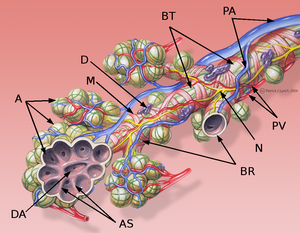
Alveolar septa (AS)
Alveolar septum: the thin wall which separates the alveoli from each other in the lungs
Orbital septum, a palpabral ligament in the upper and lower eyelids
Septum pellucidum or septum lucidum, a thin structure separating two fluid pockets in the brain
Uterine septum, a malformation of the uterus
Vaginal septum, a lateral or transverse partition inside the vagina
Intermuscular septa separating the muscles of the arms and legs
Histological septa are seen throughout most tissues of the body, particularly where they are needed to stiffen soft cellular tissue, and they also provide planes of ingress for small blood vessels. Because the dense collagen fibres of a septum usually extend out into the softer adjacent tissues, microscopic fibrous septa are less clearly defined than the macroscopic types of septa listed above. In rare instances, a septum is a cross-wall. Thus it divides a structure into smaller parts.
Cell biology
The Septum (cell biology) is the boundary formed between dividing cells in the course of cell division.
Fungus
- A partition dividing filamentous hyphae into discrete cells in fungi.
Botany
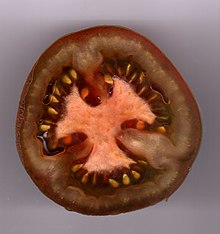
A tomato has septa that divide the fruit into chambers (locules) that contain the seeds.
- A partition that separates the locules of a fruit, anther, or sporangium.
Zoology
- a. A septum is one of the radial calcareous plates in the corallites of a coral.
b. One of the transverse partitions dividing the shell of a mollusk, or of a rhizopod, into several chambers.
c. One of the transverse partitions dividing the body cavity of an annelid.
Septum (marine biology): walls between each chamber, or siphuncle, in shells of nautiloids, ammonites, and belemnites; i.e. cephalopods that retain an external shell.
Laboratory technology
- A rubber septum is an engineered membrane that permits transfer of a substance (usually liquid or gas) without contact with air, usually using a syringe with needle.


