Little bittern

 Clash Royale CLAN TAG#URR8PPP
| Little bittern | |
|---|---|
 | |
| Little Bittern in Spain/Majorca | |
Conservation status | |
 Least Concern (IUCN 3.1)[1] | |
Scientific classification  | |
| Kingdom: | Animalia |
| Phylum: | Chordata |
| Class: | Aves |
| Order: | Pelecaniformes |
| Family: | Ardeidae |
| Genus: | Ixobrychus |
| Species: | I. minutus |
Binomial name | |
Ixobrychus minutus (Linnaeus, 1766) | |
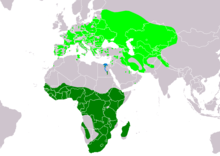 | |
| Range of I. minutus Breeding Resident Non-breeding | |
Synonyms | |
Ardea minuta Linnaeus, 1766 | |
The little bittern or common little bittern (Ixobrychus minutus) is a wading bird in the heron family, Ardeidae. Ixobrychus is from Ancient Greek ixias, a reed-like plant and brukhomai, to bellow, and minutus is Latin for "small".[2]
Contents
1 Distribution
2 Taxonomy
3 Description
4 Status
5 Behaviour
6 References
7 External links
Distribution
The little bittern is native to the Old World, breeding in Africa, central and southern Europe, western and southern Asia, and Madagascar. Birds from temperate regions in Europe and western Asia are migratory, wintering in Africa and further south in Asia, while those nesting in the tropics are sedentary. It is rare north of its breeding range.[3]
In Britain there were intermittent reports of breeding in the nineteenth century, and again in 1946 and 1957, but none of these records were proven. The first proven British breeding record is from Yorkshire in 1984,[4] and the second from the Avalon Marshes in Somerset in 2010, by 2017 this species had been present in this area for nine consecutive years.[5]
Taxonomy
Carl Linnaeus described the little bittern in 1766. The three subspecies are:
I. m. minutus – (Linnaeus, 1766): nominate, found in Europe, Asia, northern Africa; winters in sub-Saharan Africa and southern Asia
I. m. payesii – (Hartlaub, 1858): found in sub-Saharan Africa, resident
I. m. podiceps – (Bonaparte, 1855): found in Madagascar, resident
The Australian little bittern (I. dubius) and the extinct New Zealand little bittern (I. novaezelandiae) were formerly considered subspecies of the little bittern.[6]
Description

Egg, Collection Museum Wiesbaden

Immature
The little bittern has a length of 33–38 centimetres (13–15 in) and a wing span of 52–58 centimetres (20–23 in). It is the smallest of the breeding herons of Europe and is characterised by its tiny size, long and sharp bull and thick neck. The male's are distinctively patterned and both sexes show pale forewing panels. The males have black with a faint green sheen on the crown, nape, back, tail and scapulars. The underparts are pale buff and the wing has a pinkish buff oval shaped panel which contrasts with the otherwise black wings and is formed by the inner wing coverts. The underwing is completely whiteish in colour. The female is duller than the male and has brownish black upperparts with paler feather margins visible at close range. The underparts of the female are not as clean as those of the male and are streaked with dark buff and brown. The female's wing panel is less obvious than the male's. The juveniles are duller and more rufous than the females and are more heavily streaked on both their upperparts and underparts, including their wing coverts.[4]
Status
The little bittern is one of the species to which the Agreement on the Conservation of African-Eurasian Migratory Waterbirds applies.
Behaviour
The little bittern is crepuscular, skulking and normally solitary. It feeds in fishes, amphibians and insects which are caught within reedbeds or at their edges by the bird slowly stalking the prey. The male claims a territory in the Spring, advertising his presence with a deep barking or croaking call and the monogamous pair remain together for at least one breeding season. Eggs are laid in a nest situated in dense reedbeds, rushes or bushes above the water from the middle of May and there is a single brood which is normally 5-6 eggs. These are incubated for17-19 days and the chicks are fledged after 25-30 days.[4]
IN Europe the little bittern is a migratory species, crossing the Mediterraenan from Africa in the early Spring and arriving in their breeding wetlands from mid April onwards. The return to Africa occurs in August and September and there are normally only a few juveniles left in Europe by October. The European breeders migrate as far south as the Eastern Cape and Transvaal.[4]

Little bittern in the Aldomirovtsi Marsh, Bulgaria

An adult during ringing in northern Italy

An immature little bittern, camouflaged in its reed bed habitat

An immature little bittern, in the open, but still near the water

Ixobrychus minutus - MHNT


References
^ BirdLife International (2018). "Ixobrychus minutus". The IUCN Red List of Threatened Species: e.T22735766A132186190. Retrieved 25 December 2018..mw-parser-output cite.citationfont-style:inherit.mw-parser-output .citation qquotes:"""""""'""'".mw-parser-output .citation .cs1-lock-free abackground:url("//upload.wikimedia.org/wikipedia/commons/thumb/6/65/Lock-green.svg/9px-Lock-green.svg.png")no-repeat;background-position:right .1em center.mw-parser-output .citation .cs1-lock-limited a,.mw-parser-output .citation .cs1-lock-registration abackground:url("//upload.wikimedia.org/wikipedia/commons/thumb/d/d6/Lock-gray-alt-2.svg/9px-Lock-gray-alt-2.svg.png")no-repeat;background-position:right .1em center.mw-parser-output .citation .cs1-lock-subscription abackground:url("//upload.wikimedia.org/wikipedia/commons/thumb/a/aa/Lock-red-alt-2.svg/9px-Lock-red-alt-2.svg.png")no-repeat;background-position:right .1em center.mw-parser-output .cs1-subscription,.mw-parser-output .cs1-registrationcolor:#555.mw-parser-output .cs1-subscription span,.mw-parser-output .cs1-registration spanborder-bottom:1px dotted;cursor:help.mw-parser-output .cs1-ws-icon abackground:url("//upload.wikimedia.org/wikipedia/commons/thumb/4/4c/Wikisource-logo.svg/12px-Wikisource-logo.svg.png")no-repeat;background-position:right .1em center.mw-parser-output code.cs1-codecolor:inherit;background:inherit;border:inherit;padding:inherit.mw-parser-output .cs1-hidden-errordisplay:none;font-size:100%.mw-parser-output .cs1-visible-errorfont-size:100%.mw-parser-output .cs1-maintdisplay:none;color:#33aa33;margin-left:0.3em.mw-parser-output .cs1-subscription,.mw-parser-output .cs1-registration,.mw-parser-output .cs1-formatfont-size:95%.mw-parser-output .cs1-kern-left,.mw-parser-output .cs1-kern-wl-leftpadding-left:0.2em.mw-parser-output .cs1-kern-right,.mw-parser-output .cs1-kern-wl-rightpadding-right:0.2em
^ Jobling, James A (2010). The Helm Dictionary of Scientific Bird Names. London: Christopher Helm. pp. 208, 256. ISBN 978-1-4081-2501-4.
^ Rasmussen, Pamela C.; Anderton, John C. (2005). Birds of South Asia. The Ripley Guide. ISBN 978-84-87334-67-2.
^ abcd D. Snow & C.M. Perrins (1998). Birds of the Western Palearctic Concise Edition Volume 1 Non-passerines. Oxford University Press. pp. 105–107. ISBN 978-0198501879.
^ "The State of the UK's Birds 2017" (PDF). British Trust for Ornithology. Retrieved 25 December 2018.
^ Christidis, Les; Boles, Walter E. (2008). Systematics and Taxonomy of Australian Birds. CSIRO Publishing. ISBN 978-0-643-06511-6.
.mw-parser-output .refbeginfont-size:90%;margin-bottom:0.5em.mw-parser-output .refbegin-hanging-indents>ullist-style-type:none;margin-left:0.mw-parser-output .refbegin-hanging-indents>ul>li,.mw-parser-output .refbegin-hanging-indents>dl>ddmargin-left:0;padding-left:3.2em;text-indent:-3.2em;list-style:none.mw-parser-output .refbegin-100font-size:100%
del Hoyo, J.; Elliot, A.; Sargatal, J., eds. (1992). Handbook of the Birds of the World. 1. Barcelona: Lynx Edicions. pp. 425–426. ISBN 978-84-87334-10-8.
External links
 | Wikimedia Commons has media related to Ixobrychus minutus. |
 | Wikispecies has information related to Ixobrychus minutus |
Blasco-Zumeta, Javier; Heinze, Gerd-Michael. "Little bittern" (PDF). Identification Atlas of Aragon's Birds.
Little Bittern, The Atlas of Southern African Birds- BirdLife species factsheet for Ixobrychus minutus
"Ixobrychus minutus". Avibase.
"Little bittern media". Internet Bird Collection.
Little bittern photo gallery at VIREO (Drexel University)
Interactive range map of Ixobrychus minutus at IUCN Red List maps
Audio recordings of Little bittern on Xeno-canto.


