Bluethroat

 Clash Royale CLAN TAG#URR8PPP
| Bluethroat | |
|---|---|
 | |
| Wintering male from Mangaon, Maharashtra, India | |
Conservation status | |
 Least Concern (IUCN 3.1)[1] | |
Scientific classification  | |
| Kingdom: | Animalia |
| Phylum: | Chordata |
| Class: | Aves |
| Order: | Passeriformes |
| Family: | Muscicapidae |
| Genus: | Luscinia |
| Species: | L. svecica |
Binomial name | |
Luscinia svecica (Linnaeus, 1758) | |
 | |
| Distribution of the bluethroat subspecies | |
Synonyms | |
Motacilla svecica Linnaeus, 1758 | |
The bluethroat (Luscinia svecica) is a small passerine bird that was formerly classed as a member of the thrush family Turdidae, but is now more generally considered to be an Old World flycatcher, Muscicapidae. It, and similar small European species, are often called chats.
It is a migratory insectivorous species breeding in wet birch wood or bushy swamp in Europe and Asia with a foothold in western Alaska. It nests in tussocks or low in dense bushes. It winters in north Africa and the Indian subcontinent.
The bluethroat is similar in size to the European robin at 13–14 cm. It is plain brown above except for the distinctive black tail with red side patches. It has a strong white supercilium.
The male has an iridescent blue bib edged below with successive black, white and rust coloured borders. Some races, such as L. svecica svecica (red-spotted bluethroat) of northern Eurasia, have a red spot in the centre of the blue bib.
Others, such as L. svecica cyanecula (white-spotted bluethroat) of southern and central Europe, have a white spot in the centre of the blue bib. L. svecica magna in Turkey has no central spot.
Females of all races usually have just a blackish crescent on an otherwise cream throat and breast. Newly fledged juveniles are freckled and spotted dark brown above.
Despite the distinctive appearance of the males, recent genetic studies show only limited variation between the forms, and confirm that this is a single species.[2]
Moults begins in July after breeding and is completed in 40–45 days, before the birds migrate.[3]
The male has a varied and very imitative song.[4] Its call is a typical chat chack noise.
Etymology

Calling
The genus name Luscinia is Latin for the common nightingale and svecica is New Latin. The colours of the male's breast were thought to evoke the Swedish flag, the yellow in the flag being more orange hued in the 17th and 18th centuries.[5]
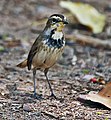
Female at Keoladeo National Park, Bharatpur, Rajasthan, India

Red-spotted race

Eggs, Collection Museum Wiesbaden, Germany
 Play media
Riyadh, KSA 1992


References
^ BirdLife International (2012). "Cyanecula svecica". IUCN Red List of Threatened Species. Version 2013.2. International Union for Conservation of Nature. Retrieved 26 November 2013..mw-parser-output cite.citationfont-style:inherit.mw-parser-output .citation qquotes:"""""""'""'".mw-parser-output .citation .cs1-lock-free abackground:url("//upload.wikimedia.org/wikipedia/commons/thumb/6/65/Lock-green.svg/9px-Lock-green.svg.png")no-repeat;background-position:right .1em center.mw-parser-output .citation .cs1-lock-limited a,.mw-parser-output .citation .cs1-lock-registration abackground:url("//upload.wikimedia.org/wikipedia/commons/thumb/d/d6/Lock-gray-alt-2.svg/9px-Lock-gray-alt-2.svg.png")no-repeat;background-position:right .1em center.mw-parser-output .citation .cs1-lock-subscription abackground:url("//upload.wikimedia.org/wikipedia/commons/thumb/a/aa/Lock-red-alt-2.svg/9px-Lock-red-alt-2.svg.png")no-repeat;background-position:right .1em center.mw-parser-output .cs1-subscription,.mw-parser-output .cs1-registrationcolor:#555.mw-parser-output .cs1-subscription span,.mw-parser-output .cs1-registration spanborder-bottom:1px dotted;cursor:help.mw-parser-output .cs1-ws-icon abackground:url("//upload.wikimedia.org/wikipedia/commons/thumb/4/4c/Wikisource-logo.svg/12px-Wikisource-logo.svg.png")no-repeat;background-position:right .1em center.mw-parser-output code.cs1-codecolor:inherit;background:inherit;border:inherit;padding:inherit.mw-parser-output .cs1-hidden-errordisplay:none;font-size:100%.mw-parser-output .cs1-visible-errorfont-size:100%.mw-parser-output .cs1-maintdisplay:none;color:#33aa33;margin-left:0.3em.mw-parser-output .cs1-subscription,.mw-parser-output .cs1-registration,.mw-parser-output .cs1-formatfont-size:95%.mw-parser-output .cs1-kern-left,.mw-parser-output .cs1-kern-wl-leftpadding-left:0.2em.mw-parser-output .cs1-kern-right,.mw-parser-output .cs1-kern-wl-rightpadding-right:0.2em
^ Zink RM, RM; Drovetski SV; Questiau S; Fadeev IV; Nesterov EV; Westberg MC; Rohwer S. (2003). "Recent evolutionary history of the bluethroat (Luscinia svecica) across Eurasia" (PDF). Molecular Ecology. 12 (11): 3069–75. doi:10.1046/j.1365-294X.2003.01981.x. PMID 14629386. Archived from the original (PDF) on 2005-04-04.
^ RSPB Handbook of British Birds (2014). UK
ISBN 978-1-4729-0647-2.
^ Metzmacher M. (2008) Les Grillons, muses de la Gorgebleue à miroir blanc (Luscinia svecica cyanecula) ? Parcs & Réserves, 63 : 17-19.
^ Jobling, James A. (2010). The Helm Dictionary of Scientific Bird Names. London, United Kingdom: Christopher Helm. pp. 233, 375. ISBN 978-1-4081-2501-4.
External links
 | Wikispecies has information related to Luscinia svecica |
 | Wikimedia Commons has media related to Luscinia svecica. |
Bluethroat videos, photos & sounds on the Internet Bird Collection- Ageing and sexing (PDF; 3.4 MB) by Javier Blasco-Zumeta & Gerd-Michael Heinze
- Information and pictures about the Bluethroat in the Netherlands
- Metzmacher M. (2008) Les Grillons, muses de la Gorgebleue à miroir blanc (Luscinia svecica cyanecula) ? Parcs & Réserves, 63 : 17-19.
Authority control  |
|
|---|

