Dryopteridaceae
Dryopteridaceae
Jump to navigation
Jump to search
| Dryopteridaceae | |
|---|---|
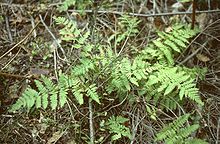 | |
Dryopteris carthusiana | |
Scientific classification  | |
| Kingdom: | Plantae |
| Division: | Pteridophyta |
| Class: | Polypodiopsida/Pteridopsida (disputed) |
| Order: | Polypodiales |
| Suborder: | Polypodiineae |
| Family: | Dryopteridaceae Herter 1949 (nom. cons.) |
| Subfamilies | |
| |
The Dryopteridaceae are a family of leptosporangiate ferns in the order Polypodiales. They are known colloquially as the wood ferns. They comprise about 1700 species and have a cosmopolitan distribution. They may be terrestrial, epipetric, hemiepiphytic, or epiphytic. Many are cultivated as ornamental plants.[2] The largest genera are Elaphoglossum (600), Polystichum (260), Dryopteris (225), and Ctenitis (150). These four genera contain about 70% of the species.[3] Dryopteridaceae diverged from the other families in eupolypods I about 100 million years ago.[4]
Contents
1 Description
2 Taxonomy
2.1 History
2.2 Subdivision
3 References
4 Bibliography
5 External links
Description[edit]
The rhizomes are often stout, creeping, ascending, or erect, and sometimes scandent or climbing, with nonclathrate scales at apices. Fronds are usually monomorphic, less often dimorphic, or sometimes scaly or glandular, but less commonly hairy. Petioles have numerous round, vascular bundles arranged in a ring, or rarely as few as three; the adaxial bundles are largest. Veins are pinnate or forking, free to variously anastomosing; the areoles occur with or without included veinlets; sori are usually round, acrostichoid (covering the entire abaxial surface of the lamina) in a few lineages; usually indusiate, or sometimes exindusiate. Indusia, when present, are round-reniform or peltate. Sporangia have three-rowed, short to long stalks; spores arereniform, monolete, perine or winged.[3]
Taxonomy[edit]
History[edit]
In 1990, Karl U. Kramer and coauthors defined the Dryopteridaceae broadly to include the present family, as well as the Woodsiaceae sensu lato, Onocleaceae, and most of Tectariaceae.[5]Molecular phylogenetic studies found Kramer's version of the Dryopteridaceae to be polyphyletic, and it was split up by Smith and others in 2006.[3] The inclusion of Didymochlaena, Hypodematium, and Leucostegia in the Dryopteridaceae is doubtful. If these three are excluded, then the family is strongly supported as monophyletic in cladistic analyses.[6] Some authors have already treated these genera as outside of the Dryopteridaceae.[1]
In 2007, a phylogenetic study of DNA sequences showed that Pleocnemia should be transferred from the Tectariaceae to the Dryopteridaceae.[7] In 2010, in a paper on bolbitidoid ferns, Arthrobotrya was resurrected from Teratophyllum.[8] Later that year, Mickelia was described as a new genus.[9]
Some species have been removed from the genus Oenotrichia because they do not belong there or even in the family Dennstaedtiaceae where Oenotrichia sensu stricto is placed. These species probably belong in the Dryopteridaceae, but have not yet been given a generic name.[6]
In 2012, a phylogenetic study of Dryopteris and its relatives included Acrophorus, Acrorumohra, Diacalpe, Dryopsis, Nothoperanema, and Peranema within that genus.[10] The Flora of China treatment of the family, published in 2013, used phylogenetic results to sink Lithostegia and Phanerophlebiopsis into Arachniodes.[11]
The Dryopteridaceae Herter, under the classification system of Christenhusz and Chase (2014), are submerged as subfamily Dryopteridoideae Link, one of eight subfamilies constituting family Polypodiaceae. This family corresponds to the clade Eupolypods I.[12]
Subdivision[edit]
The PPG I classification divides the family into three subfamilies, listed below.[13]
Subfamily Polybotryoideae H.M.Liu & X.C.Zhang
- Genera: Cyclodium, Maxonia, Olfersia, Polybotrya, Polystichopsis, Stigmatopteris, Trichoneuron
- Genera: Cyclodium, Maxonia, Olfersia, Polybotrya, Polystichopsis, Stigmatopteris, Trichoneuron
Subfamily Elaphoglossoideae (Pic.Serm.) Crabbe, Jermy & Mickel
- Genera: Arthrobotrya, Bolbitis, Elaphoglossum, Lastreopsis, Lomagramma, Megalastrum, Mickelia, Parapolystichum, Pleocnemia, Rumohra, Teratophyllum
- Genera: Arthrobotrya, Bolbitis, Elaphoglossum, Lastreopsis, Lomagramma, Megalastrum, Mickelia, Parapolystichum, Pleocnemia, Rumohra, Teratophyllum
Subfamily Dryopteridoideae Link
- Genera: Arachnoides, Ctenitis, Cyrtomium, Dryopteris, Phanerophlebia, Polystichum
- Genera: Arachnoides, Ctenitis, Cyrtomium, Dryopteris, Phanerophlebia, Polystichum
The following table shows the currently accepted Dryopteridaceae generic names and the corresponding synonyms.
Accepted generic names[3] Synonyms[14][15]
Arachniodes Blume 1828
Byrsopteris C.V.Morton 1960[11]
Leptorumohra (H.Itô) H.Itô 1938[11]
Lithostegia Ching 1933[11]
Phanerophlebiopsis Ching 1965[11]
Arthrobotrya J.Sm. 1875
Bolbitis Schott 1834
Anapausia C. Presl
Campium C. Presl
Cyrtogonium J.Sm.
Edanyoa Copel.
Egenolfia Schott 1836
Heteroneurum C.Presl
Jenkinsia Hook.
Poecilopteris C.Presl
Ctenitis (C.Chr.) C.Chr. 1938
Atalopteris Maxon & C. Chr.
Ataxipteris Holttum 1984
Cyclodium C.Presl 1836
Cyrtomium C.Presl 1836
Amblia C. Presl
Cyrtogonellum Ching 1938
Cyrtomidictyum Ching 1940
Dryopteris Adans. 1763
Acrophorus C. Presl 1836[10]
Acrorumohra (H.Itô) H.Itô 1938[10]
Arthrobotrys (C.Presl) Lindl. 1846
Diacalpe Blume 1828
Dichasium (A.Braun) Fée 1852
Diclisodon T.Moore 1857
Dryopsis Holttum & P.J.Edwards 1986[10]
Filix Ség. 1754
Filix-mas Hill ex Farw. 1931
Lophodium Newman 1851
Nephrodium Marthe ex Michx. 1803
Nothoperanema (Tagawa) Ching 1966[10] – Island Lacefern[16]
Peranema D.Don 1825[10]
Pteris Gled. ex Scop. 1753
Pycnopteris T. Moore 1855
Revwattsia D.L.Jones 1998
Sphaeropteris R.Br. ex Wall. 1830 (non Bernh. 1801)[10]
Stenolepia Alderw. 1909
Elaphoglossum Schott ex J. Sm. 1842
Aconiopteris C.Presl 1836
Dictyoglossum J.Sm. 1846
Hymenodium Fée 1845
Microstaphyla C.Presl 1851
Peltapteris Link 1841
Rhipidopteris Schott ex Fée 1845
Lastreopsis Ching 1938
Coveniella M.D.Tindale 1986
Lomagramma J.Sm. 1841
Cheiloepton Fée 1845
Maxonia C.Chr. 1916
Megalastrum Holttum 1986
Mickelia R.C.Moran, Labiak & Sundue 2010
Olfersia Raddi 1819
Dorcapteris C.Presl 1851
Parapolystichum (Keyserl.) Ching 1940
Phanerophlebia C. Presl 1836
Pleocnemia C.Presl 1836
Polybotrya Humb. & Bonpl. ex Willd. 1810
Soromanes Fée 1845
Polystichopsis (J.Sm.) Holttum 1947
Polystichum Roth 1800
Acropelta T.Nakai 1953
Adenoderris J.Sm. 1875
Aetopteron Ehrh. ex House 1920
Hemesteum H.Lév. 1915
Hypopeltis Michx. 1803
Papuapteris C. Chr. 1937
Plecosorus Fée 1852
Sorolepidium Christ 1911
Rumohra Raddi 1819
Stigmatopteris C.Chr. 1909
Teratophyllum Mett. ex Kuhn 1870
Trichoneuron Ching 1965[17]
Didymochlaena has been removed to Didymochlaenaceae, and Hypodematium and Leucostegia to Hypodematiaceae. Aenigmopteris has at times been suggested to belong to this family, on the grounds of its morphological similarity to Ctenitis, but molecular phylogeny has led to its submersion within Tectaria.[18] Likewise, Dryopolystichum has been placed in Lomariopsidaceae.[19]
References[edit]
^ ab Christenhusz, Maarten J. M.; Zhang, Xian-Chun; Schneider, Harald (18 February 2011). "A linear sequence of extant families and genera of lycophytes and ferns" (PDF). Phytotaxa. 19: 7–54. ISSN 1179-3163.
^ Sue Olsen. 2007. Encyclopedia of Garden Ferns Timber Press: Portland, OR, USA. ISBN 978-0-88192-819-8
^ abcd Smith et al., 2006 Archived February 26, 2008, at the Wayback Machine. Alan R. Smith, Kathleen M. Pryer, Eric Schuettpelz, Petra Korall, Harald Schneider & Paul G. Wolf: "A classification for extant ferns," Taxon, 55(3): 705–731 (Aug 2006)
^ Eric Schuettpelz and Kathleen M. Pryer. 2009. "Evidence for a Cenozoic radiation of ferns in an angiosperm-dominated canopy". Proceedings of the National Academy of Sciences 106(27):11200-11205. doi:10.1073/pnas.0811136106
^ Karl U. Kramer (with Richard E. Holttum, Robin C. Moran, and Alan R. Smith). 1990. "Dryopteridaceae". pages ??. In: Klaus Kubitzki (general editor); Karl U. Kramer and Peter S. Green (volume editors) The Families and Genera of Vascular Plants volume I. Springer-Verlag: Berlin;Heidelberg, Germany. ISBN 978-0-387-51794-0
^ ab Alan R. Smith, Kathleen M. Pryer, Eric Schuettpelz, Petra Korall, Harald Schneider, and Paul G. Wolf. 2008. "Dryopteridaceae". pages ??. In: "Fern Classification". pages 417-467. In: Tom A. Ranker and Christopher H. Haufler (editors). Biology and Evolution of Ferns and Lycophytes. Cambridge University Press. ISBN 978-0-521-87411-3
^ Hong-Mei Liu, Xian-Chun Zhang, Wei Wang, Yin-Long Qiu, and Zhi-Duan Chen. 2007. "Molecular Phylogeny of the Fern Family Dryopteridaceae inferred from Chloroplast rbcL and atpB genes". International Journal of Plant Sciences 168(9):1311-1323. doi:10.1086/521710
^ Robbin C. Moran, Paulo H. Labiak, and Michael Sundue. 2010. "Phylogeny and character evolution of the bolbitidoid ferns (Dryopteridaceae)". International Journal of Plant Sciences 171(5):547-559. doi:10.1086/652191
^ Robbin C. Moran, Paulo H. Labiak, and Michael Sundue. 2010. "Synopsis of Mickelia, a newly recognized genus of bolbitidoid ferns (Dryopteridaceae)". Brittonia 62(4):337-356.
^ abcdefg Li-Bing Zhang, Liang Zhang, Shi-Yong Dong, and Atsushi Ebihara. 2012. "Molecular circumscription and major evolutionary lineages of the fern genus Dryopteris (Dryopteridaceae)". BMC Evolutionary Biology 12(1):180
^ abcde He H, Wu SG, Xiang JY, Barrington DS (2013) "Arachniodes". In: Wu ZY, Raven PH, Hong DY (eds) Flora of China, vol 2–3.
^ Christenhusz & Chase 2014.
^ Pteridophyte Phylogeny Group (November 2016). "A community-derived classification for extant lycophytes and ferns". Journal of Systematics and Evolution. 54 (6): 563–603. doi:10.1111/jse.12229.
^ Family:Dryopteridaceae USDA-ARS Germplasm Resources Information Network (GRIN) 25 Jan 2012
^ Dryopteridaceae Tropicos.org. Missouri Botanical Garden. 25 Jan 2012
^ "Nothoperanema". Natural Resources Conservation Service PLANTS Database. USDA. Retrieved 25 January 2012.
^ Hong-Mei Liu, Xian-Chun Zhang, Mei-Ping Wang, Hui Shang, Shi-Liang Zhou, Yue-Hong Yan, Xue-Ping Wei, Wen-Bin Xu, Harald Schneider. 2016. "Phylogenetic placement of the enigmatic fern genus Trichoneuron informs on the infra-familial relationship of Dryopteridaceae". Plant Systematics and Evolution 302:319–332
^ Chen, Cheng-Wei; RothfelsE, Carl J.; Mustapeng, Andi Maryani A.; Gubilil, Markus; Karger, Dirk Nikolaus; Kessler, Michael; Huang, Yao-Moan. "End of an enigma: Aenigmopteris belongs in Tectaria (Tectariaceae: Polypodiopsida)". Journal of Plant Research. doi:10.1007/s10265-017-0966-9.
^ Chen, Cheng-Wei; Sundue, Michael; Kuo, Li-Yaung; Teng, Wei-Chih; Huang, Yao-Moan. "Phylogenetic analyses place the monotypic Dryopolystichum within Lomariopsidaceae". PhytoKeys. 78: 83–107. doi:10.3897/phytokeys.78.12040.
Bibliography[edit]
.mw-parser-output .refbeginfont-size:90%;margin-bottom:0.5em.mw-parser-output .refbegin-hanging-indents>ullist-style-type:none;margin-left:0.mw-parser-output .refbegin-hanging-indents>ul>li,.mw-parser-output .refbegin-hanging-indents>dl>ddmargin-left:0;padding-left:3.2em;text-indent:-3.2em;list-style:none.mw-parser-output .refbegin-100font-size:100%
Christenhusz, Maarten J.M. & Chase, Mark W. (2014). "Trends and concepts in fern classification". Annals of Botany. 113 (9): 571–594. doi:10.1093/aob/mct299. PMC 3936591 . PMID 24532607.
Smith, Alan R.; Pryer, Kathleen M.; Schuettpelz, Eric; Korall, Petra; Schneider, Harald; Wolf, Paul G. (1 January 2006). "A Classification for Extant Ferns" (PDF). Taxon. 55 (3): 705–731. doi:10.2307/25065646. JSTOR 25065646.

External links[edit]
- Phytotaxa
Categories:
- Dryopteridaceae
- Pteridophyta families


(window.RLQ=window.RLQ||).push(function()mw.config.set("wgPageParseReport":"limitreport":"cputime":"0.580","walltime":"0.709","ppvisitednodes":"value":6324,"limit":1000000,"ppgeneratednodes":"value":0,"limit":1500000,"postexpandincludesize":"value":51734,"limit":2097152,"templateargumentsize":"value":9546,"limit":2097152,"expansiondepth":"value":20,"limit":40,"expensivefunctioncount":"value":18,"limit":500,"unstrip-depth":"value":0,"limit":20,"unstrip-size":"value":17391,"limit":5000000,"entityaccesscount":"value":18,"limit":400,"timingprofile":["100.00% 603.967 1 -total"," 42.84% 258.767 1 Template:Automatic_taxobox"," 41.17% 248.663 1 Template:Taxobox/core"," 24.71% 149.234 1 Template:Reflist"," 19.11% 115.405 1 Template:Taxobox/taxonomy"," 18.77% 113.371 1 Template:Taxonbar"," 11.49% 69.370 52 Template:Taxon_info"," 10.95% 66.130 6 Template:Cite_journal"," 7.60% 45.926 6 Template:Taxon_link"," 5.87% 35.466 3 Template:ISBN"],"scribunto":"limitreport-timeusage":"value":"0.298","limit":"10.000","limitreport-memusage":"value":5195431,"limit":52428800,"cachereport":"origin":"mw1304","timestamp":"20180826041751","ttl":1900800,"transientcontent":false);mw.config.set("wgBackendResponseTime":100,"wgHostname":"mw1242"););

 Clash Royale CLAN TAG
