Jovian (emperor)
Jovian (emperor)
Jump to navigation
Jump to search
| Jovian | |||||||||
|---|---|---|---|---|---|---|---|---|---|
Augustus | |||||||||
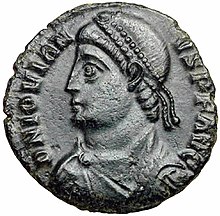 Solidus of emperor Jovian | |||||||||
| Emperor of the Roman Empire | |||||||||
| Reign | 27 June 363 – 17 February 364 | ||||||||
| Predecessor | Julian the Apostate | ||||||||
| Successor | Valentinian I | ||||||||
| Born | 331 Singidunum (modern Belgrade, Serbia) | ||||||||
| Died | 17 February 364 (aged 33) Dadastana (in Anatolia) | ||||||||
| Burial | Church of the Holy Apostles, Constantinople | ||||||||
| Wife |
| ||||||||
| Issue | Two sons, one named Varronianus (consul in 364), c. 380 | ||||||||
| |||||||||
| Father | Varronianus | ||||||||
| Religion | Christianity | ||||||||
Jovian (Latin: Flavius Jovianus Augustus;[1]Greek: Ἰοβιανός; 331 – 17 February 364) was Roman Emperor from 363 to 364. Upon the death of emperor Julian the Apostate during his campaign against the Sassanid Empire, Jovian was hastily declared emperor by his soldiers. He sought peace with the Persians on humiliating terms and reestablished Christianity as the state church. His reign lasted only eight months.
Contents
1 Rise to power
2 Restoration of Christianity
3 Rule
4 See also
5 References
6 Further reading
7 External links
Rise to power[edit]
Jovian was born at Singidunum (today Belgrade in Serbia) in 331 AD, the son of Varronianus, the commander of Constantius II's imperial bodyguards (comes domesticorum). He also joined the guards and by 363 had risen to the same command that his father had once held. In this capacity, Jovian accompanied the Emperor Julian on the Mesopotamian campaign of the same year against Shapur II, the Sassanid king. After the Battle of Samarra, a small but decisive engagement, the Roman army was forced to retreat from the numerically superior Persian force. Julian, mortally wounded during the retreat, died on 26 June 363. The next day, after the aged Saturninius Secundus Salutius, praetorian prefect of the Orient, had declined the purple, the choice of the army fell upon Jovian.[2] His election caused considerable surprise: Ammianus Marcellinus suggests that he was wrongly identified with another Jovianus, chief notary (primicerius notariorum), whose name also had been put forward, or that during the acclamations the soldiers mistook the name Jovianus for Julianus, and imagined that the latter had recovered from his illness. An easy gaiety and indulgent (perhaps self-indulgent) disposition was the chief recommendation of the new emperor.[3]
Restoration of Christianity[edit]
Jovian, a Christian, reestablished Christianity as the state church, ending the brief revival of paganism under his predecessor.[4] Upon arriving at Antioch, he revoked the edicts of Julian against Christians.[5] The Labarum of Constantine the Great again became the standard of the army.[6] He issued an edict of toleration, to the effect that, while the exercise of magical rites would be punished, his subjects should enjoy full liberty of conscience.[7]
In 363, however, he issued an edict ordering the Library of Antioch to be burnt down,[8] and another on 11 September subjecting those who worshiped ancestral gods to the death penalty. He extended the same punishment on 23 December to participation in any pagan ceremony (even private ones).[9] Jovian entertained a great regard for Athanasius, whom he reinstated on the archiepiscopal throne,[5] desiring him to draw up a statement of the orthodox faith. However, Jovian did not display the single-minded zeal of his Flavian predecessors in the cause of either heresy or orthodoxy, but was content to recommend moderation to the contending factions in the ongoing Arian controversy.[10] In Syriac literature, Jovian became the hero of a Christian romance. In part due to his influence,[11] Christianity remained the dominant religion of both the Western and Eastern Roman Empires, until the Fall of Constantinople to the Turks in 1453.
Rule[edit]
On the very morning of his accession, Jovian resumed the retreat begun by Julian. Though harassed by the Persians, the army succeeded in reaching the city of Dura on the banks of the Tigris. There the army came to a halt, hoping to cross the Tigris to reach the Empire on the western bank. When the attempt to bridge the river failed, he was forced to sue for a peace treaty on humiliating terms. According to Edward Gibbon,[12] there were just sufficient provisions in the camp to last the army until the friendly province of Corduene, 100 miles to the north, if its movements were prompt and decisive. But Jovian delayed, and the supplies ran out while he was engaged in the negotiations, forcing him to comply with Shapur II's harsh terms. In exchange for an unhindered retreat to his own territory, he agreed to withdraw from the five Roman provinces east of the Tigris, conquered by Galerius in 298, that Diocletian had annexed, and to allow the Persians to occupy the fortresses of Nisibis, Castra Maurorum and Singara. The Romans also surrendered their interests in the Kingdom of Armenia to the Persians. The Christian king of Armenia, Arsaces II (Arshak II), was to stay neutral in future conflicts between the two empires and was forced to cede part of his kingdom to Shapur. The treaty was widely seen as a disgrace and Jovian rapidly lost popularity.[13] The clamors and insults of the citizenry of Antioch, who were left destitute of security on an exposed frontier, impelled him to hasten his departure from that city.[14]
After arriving at Antioch, Jovian decided to rush to Constantinople to consolidate his political position there, and he delayed only to conduct the funeral of Julian, who was honorably interred at Tarsus.[15] While en route from there to the capital, after having received the allegiance of the western representatives at Tyana, Jovian was found dead in bed in his tent at Dadastana, halfway between Ancyra and Nicaea. His death was officially attributed to either a surfeit of mushrooms and wine, (his private life was notoriously dissipated)[16]or the poisonous carbon monoxide fumes of a charcoal warming fire.[17] However, the historian Ammianus Marcellinus, a near-contemporary, suggests his death was suspicious and was strangely uninvestigated.[17] Gibbon, conversely, declines to credit the suspicion.[18]
Jovian was buried in the Church of the Holy Apostles in Constantinople, along with his Christian predecessors.[19]
See also[edit]

- List of Byzantine emperors
References[edit]
^ In Classical Latin, Jovian's name was inscribed as FLAVIVS IOVIANVS AVGVSTVS.
^ Edward Gibbon, The Decline And Fall Of The Roman Empire, (The Modern Library, 1932), chap. XXIV., p. 830
^ Gibbon, Ibid., p. 831
^ Gibbon, Ibid. chap. XXV., P. 841
^ ab Philologic Results
^ Reigns Of Jovian, Valentinian and the Division of the Empire@Everything2.com
^ CATHOLIC ENCYCLOPEDIA: Flavius Claudius Jovianus
^ Michael von Albrecht and Gareth L. Schmeling, A history of Roman literature (1997), page 1744
^ Vlasis Rassias A history of unconditional love (2005); currently in publication only in Greek, as Μια ιστορία αγάπης
^ Edward Gibbon, The Decline And Fall Of The Roman Empire, (The Modern Library, 1932), chapter XXV., p. 842
^ Gibbon, Ibid. p. 843
^ The Decline And Fall Of The Roman Empire, (The Modern Library), chapter XXIV., p. 833
^ Gibbon, Ibid. p. 836-37
^ Ibid. chapter XXV., p. 844
^ Ibid. chap. XXIV., p. 838,840
^ Gibbon, Ibid. chap. XXIV., P. 830, 838; chap. XXV., p.844
^ ab Ammianus Marcellinus, The History, 25.10.12
^ Gibbon, Ibid. p. 845
^ Gibbon, Ibid.
Further reading[edit]
- Banchich, Thomas, "Jovian", De Imperatoribus Romanis.
Ammianus Marcellinus, xxv. 5–10- J. P. de la Bleterie, Histoire de Jovien (1740)
- Gibbon, Decline and Fall, chapters xxiv., xxv.
- Gibbon, Edward, 1737–1794. The history of the decline and fall of the Roman Empire. (NY : Knopf, 1993), v. 2, pp. 517 – 529.
- G. Hoffmann, Julianus der Abtrünnige, 1880
- J. Wordsworth in Smith and Wace's Dictionary of Christian Biography
- H. Schiller, Geschichte der römischen Kaiserzeit, volume ii. (1887)
- A. de Broglie, L'Église et l'empire romain au IVe siècle (4th ed. 1882).
 This article incorporates text from a publication now in the public domain: Chisholm, Hugh, ed. (1911). "Jovian". Encyclopædia Britannica. 15 (11th ed.). Cambridge University Press. p. 526.
 This article incorporates text from a publication now in the public domain: Chisholm, Hugh, ed. (1911). "Jovian". Encyclopædia Britannica. 15 (11th ed.). Cambridge University Press. p. 526.
External links[edit]
 Media related to Jovian at Wikimedia Commons
| Regnal titles | ||
|---|---|---|
| Preceded by Julian | Roman Emperor 363–364 | Succeeded by Valentinian I and Valens |
| Political offices | ||
| Preceded by Julian IV, and Flavius Sallustius | Consul of the Roman Empire 364 with Varronianus | Succeeded by Valentinian I, and Valens |
Authority control  |
|
|---|
Categories:
- 331 births
- 364 deaths
- Burials at the Church of the Holy Apostles
- Persecution of pagans in the late Roman Empire
- 4th-century Roman emperors
- 4th-century Byzantine emperors
- 4th-century Christians
- Imperial Roman consuls
- People from Belgrade
- Flavii
- Illyrian people
- Deaths from carbon monoxide poisoning


(window.RLQ=window.RLQ||).push(function()mw.config.set("wgPageParseReport":"limitreport":"cputime":"0.524","walltime":"0.655","ppvisitednodes":"value":2738,"limit":1000000,"ppgeneratednodes":"value":0,"limit":1500000,"postexpandincludesize":"value":57195,"limit":2097152,"templateargumentsize":"value":2144,"limit":2097152,"expansiondepth":"value":12,"limit":40,"expensivefunctioncount":"value":6,"limit":500,"unstrip-depth":"value":0,"limit":20,"unstrip-size":"value":6227,"limit":5000000,"entityaccesscount":"value":1,"limit":400,"timingprofile":["100.00% 507.680 1 -total"," 27.00% 137.087 1 Template:Lang-la"," 18.71% 94.977 1 Template:Infobox_Roman_emperor"," 16.63% 84.405 2 Template:Infobox"," 12.70% 64.492 1 Template:EB1911"," 12.19% 61.865 1 Template:Authority_control"," 10.52% 53.416 1 Template:Cite_EB1911"," 8.28% 42.061 1 Template:Cite_encyclopedia"," 5.54% 28.135 1 Template:Use_dmy_dates"," 4.41% 22.381 1 Template:Reflist"],"scribunto":"limitreport-timeusage":"value":"0.244","limit":"10.000","limitreport-memusage":"value":11981395,"limit":52428800,"cachereport":"origin":"mw1228","timestamp":"20180902152430","ttl":1900800,"transientcontent":false);mw.config.set("wgBackendResponseTime":78,"wgHostname":"mw1241"););
 Clash Royale CLAN TAG

