Nautilus Pompilius (band)
| Nautilus Pompilius | |
|---|---|
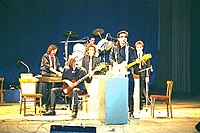 Nautilus Pompilius in concert, late 1980s. | |
| Background information | |
| Origin | USSR, Russia |
| Genres | Art rock, post-punk, new wave, gothic rock, alternative rock |
| Years active | 1983–1997 |
| Associated acts | U-Piter, Televizor, DDT |
| Past members | Vyacheslav Butusov Dmitry Umetsky Ilya Kormiltsev† Aleksey Mogilevsky Nikolay Petrov† Albert Potapkin Andrey Sadnov Igor Goncharov Aleksandr Zarubin Anastasiya Poleva Viktor Komarov Vladimir Nazimov Aleksey Khomenko Yegor Belkin Vladimir Yelizarov Igor Dzhavad-Zade Aleksandr Belyayev |
Nautilus Pompilius (Russian: Наутилус Помпилиус), sometimes nicknamed Nau (Russian: Нау), was an influential Soviet, and later Russian, rock band[1] founded in 1983 by Vyacheslav Butusov and Dmitry Umetsky, the band's lead singer and bassist respectively. After multiple successful albums and several different iterations of the band, which had gone through 16 different musicians throughout its life, Vyacheslav Butusov disbanded the group in 1997.
Contents
1 Name
2 History
2.1 Founding
2.2 Later
3 Members
4 Discography
5 References
6 External links
Name
At its founding, the band was originally named "Ali-Baba and the Forty Thieves" (Russian: "Али-Баба и сорок разбойников"). In 1983, at the suggestion of the band's sound director Andrei Makarov, the band's name was changed to Nautilus. In 1985, the name lengthened to Nautilus Pompilius under the initiative of Ilya Kormiltsev. This was done to avoid confusion with other Russian rock bands at the time also named Nautilus, such as the Moscow band lead by Evgeny Margulis.
The band later elaborated on the name, saying "The band is named after the nudibranch mollusc, which is naturally beautiful and charming." Nautilus pompilius is the scientific name of a species of cephalopod (mistakenly called a nudibranch by the band) commonly known as the Chambered Nautilus.
History
Founding
First steps were made by Vyacheslav Butusov and Dmitry Umetsky in the late 70's. At first, the band acted at small events singing songs of foreign performers and famous native performers like Mashina Vremeni and Voskreseniye. The band was formed by Vyacheslav Butusov and Dmitry Umetsky while the two studied in Sverdlovsk (now Yekaterinburg) Institute of Architecture (now called Urals Academy of Architecture).
First attempts to record their own songs were made in 1982. Their first album "Pereyezd" was released in 1983. It included both some songs which had been recorded in 1982 and new songs. The album was recorded under the noticeable influence of Led Zeppelin.
Later
The band, with its various incarnations, was active between the years 1983 and 1997. Nautilus was an influential band in the post-punk, new wave wing of Russian rock music and also a landmark of the "Ural rock" style with their philosophical lyrics. Some of their early hits are popularly associated with the Perestroika period. Their songs also accompanied the movie Brother. A version of their popular song, "Bound by One Chain" ("Скованные одной цепью") appeared in the film Stilyagi. The band hired English guitarist Bill Nelson to produce their 1997 album Yablokitay (Russian: Яблокитай) on which Nelson also plays the guitar. Since the group disbanded, Vyacheslav Butusov has launched a successful solo career.
Even though Butusov composed most of the band's songs and wrote some of their lyrics, poet Ilya Kormiltsev was one of the key contributors as a songwriter and producer.
Members

Discography
| Year | Russian name | English transliteration (translation) |
|---|---|---|
| 1983 | Переезд | Pereyezd (Resettlement (or Highway Crossing)) |
| 1985 | Невидимка | Nevidimka (The Invisible One) |
| 1986 | Разлука | Razluka (Separation), a name of a Russian folk song featuring in the album |
| 1987–1988 | Ни Кому Ни Кабельность (LIVE) | Ni Komu Ni Kabel'nost (pun; nekommunikabel'nost means 'lack of sociability' (a loanword, from communicate and -able-) and nikomu ni means 'to nobody' |
| 1988 | Князь Тишины | Knyaz' Tishiny (Prince of Silence), after a poem by Endre Ady |
| 1988 | Отбой (LIVE) | Otboy (Lights-out) |
| 1989 | Человек без имени | Chelovek Bez Imeni (Man With No Name) |
| 1992 | Чужая земля | Chuzhaya Zemlya (Foreign Land) |
| 1994 | Титаник | Titanic |
| 1994 | Титаник-LIVE | Titanic-LIVE |
| 1995 | Крылья | Kryl'ya (Wings) |
| 1996 | Лучшие Песни (LIVE) | Luchshie Pesni (Best Songs) |
| 1997 | Яблокитай | Yablokitay (China-apple, Dutch etymologization of Russian apel'sin 'orange fruit') |
| 1997 | Атлантида | Atlantida (Atlantis) |
Among their most well-known songs are: The Prince of Silence ("Князь тишины"), "Walks on Water" ("Прогулки по воде"), "The Last Letter" ("Последнее письмо", also known as "Goodbye, America"), "The Glance from the Screen" ("Взгляд с экрана"), "Hlop-Hlop" ("Хлоп-хлоп"), "The Khaki Sphere" ("Шар цвета хаки"), "Bound by One Chain" ("Скованные одной цепью"), "I Want to Be with You" ("Я хочу быть с тобой"), "On the Shore of the Nameless River" ("На берегу безымянной реки"), and "Wings" ("Крылья").
References
^ Nautilus Pompilius // Encyclopaedia of Contemporary Russian culture, 2013
External links
Nautilus Pompilius' history at Allmusic.com
Nautilus Pompilius at discogs.com- Discography with Lyrics and English translations
- About the band
Nautilus Pompilius On-Line - Official web site (in Russian)
Zvuki.ru - Nautilus pompilius (in Russian)
Official Website of Butusov & U-Piter Vyacheslav Butusov's current group (Nautilus Pompilius' front man) (in Russian)
Authority control  |
|
|---|
